Interesting articles, June 2026

The U.S. and Iran continued trading blows while simultaneously working on a peace deal:

A schism has developed between America and Israel over the Iran War:

The peace deal between the U.S. and Iran does not alter the fundamental balance of power that existed before the war and punts on the hardest issues (Iran’s nuclear program, missiles, and whether it can be recompensed in some form for the damage they suffered). It wasn’t worth it.
https://www.nytimes.com/2026/06/18/world/middleeast/iran-deal-oil-strait-of-hormuz-nuclear.html

This guy has earned an early retirement: ‘Pilot of fighter jet downed over Iran was previously shot down in Kuwaiti friendly fire incident, sources say’
https://www.cbsnews.com/news/fighter-jet-pilot-downed-iran-previously-shot-down-kuwaiti-friendly-fire/

The pilot claims a swarm to Iranian drones, including some resembling jellyfish, tried attacking him before the crash.
https://www.cnn.com/2026/06/23/politics/iran-drones-f-15-pilot-intelligence

‘This is the first known instance of a drone boat being used to recover personnel as part of a search and rescue mission’
https://www.twz.com/sea/this-is-the-corsair-drone-boat-that-plucked-the-downed-apache-crew-out-of-the-gulf-of-oman

The U.S. retired the last of its iconic Harrier jump jets, leaving Italy and Spain as the only users.
https://www.twz.com/air/marines-av-8-harrier-jump-jet-takes-its-final-bow

European multinational defense projects have a poor track record: ‘Germany and France drop joint fighter jet project’
https://www.reuters.com/business/aerospace-defense/german-french-leaders-unable-resolve-fcas-fighter-jet-dispute-sources-say-2026-06-08/

Thailand still uses U.S.-made, WWII-era M41 Walker Bulldog light tanks. They’re so old that they have to be towed around by younger tanks. The Thais towed them to points along the Cambodian border during the recent conflict, covered them in sandbags, and used them as fixed defensive points.
https://x.com/AnnQuann/status/2042280939045470229

Something like “Operation Tracer” will become common once robots are more ubiquitous. Imagine small surveillance drones operating from a “nest” close to a military base, port, or other point of interest.
https://en.wikipedia.org/wiki/Operation_Tracer

‘Spy turtles’ and ‘spy fish’ being used to monitor Chinese waters, Beijing claims
https://www.theguardian.com/world/2026/jun/12/china-spy-turtles-spy-fish-monitor-waters-claims

A Ukrainian drone attack on an oil terminal in Moscow caused spectacular damage.
https://www.reuters.com/business/energy/moscow-oil-refinery-hit-by-drone-attacks-is-unlikely-resume-production-this-year-2026-06-24/

Ukrainian drones struck an oil terminal in St. Petersburg, Russia’s second-largest and second-most-important city.
https://apnews.com/article/russia-ukraine-petersburg-oil-terminal-putin-drone-887969921c595f3a81c3b6c0b120b5f3

Ukraine claims the world’s first fully autonomous drone kill of a human. They say the incident happened two years ago.
https://www.newscientist.com/article/2529849-fully-autonomous-drones-have-killed-human-soldiers-for-the-first-time/

The Ukraine War is now longer than WWI.
https://www.nytimes.com/2026/06/11/world/europe/ukraine-russia-world-war-i.html

‘Some say this is now the future of wars in which states seek to capture territory: two sides endlessly pinned down by small, cheap and all-seeing killers. General Valery Zaluzhny, Ukraine’s ambassador to London and formerly its commander-in-chief, says that large-scale manoeuvre warfare—armies moving with speed and shock, in contrast to frontal, attritional battles—is now “unattainable”. It will become possible again only when wars evolve into robot-on-robot fighting at machine speed.

Others treat this as fanciful. Stephen Biddle, a professor at Columbia University, argues that the scale of the sensor revolution is “easy to exaggerate”. As new counter-drone systems—lasers are especially promising—appear, and as jammers and dazzlers blind satellites, the balance may tilt again, bringing some relief to ground forces.

…’When Mr Lee says Ukraine is in a “world-war-one moment”, it is tempting simply to understand him in terms of immobility and attrition. But he is also thinking about the new tactics of 1918 which, by combining surprise, right-first-time “predicted” artillery fires and small, well-drilled assault teams, made decisive breakthroughs possible again and brought the trench warfare to an end. “Defensive capabilities have taken the advantage,” he says. “Now we’re going to see the demands for technology and tactics that will help re-establish manoeuvre.”’
https://www.economist.com/interactive/essay/2026/05/28/the-dangerous-delusion-of-modern-warfare

Geoffrey Hinton, who won Nobel Prize for AI research, says AIs are already conscious.
https://youtu.be/OV_WXmuHaiI?si=_JWYMlWPLL4JWqnI

‘Microsoft AI chief [Mustafa Suleyman] walks back comments about AI taking over white-collar work’
https://www.theverge.com/tech/946879/microsoft-mustafa-suleyman-ai-white-collar-jobs

The U.S. government forced Anthropic to sharply restrict usage of its newest and most powerful LLM, “Mythos”, after a client figured out how to override its safety guardrails. Mythos’ ability to hack into other computers is as good as or better than elite human hackers. Ideological and personality differences between Trump and Anthropic’s founder may have also played a role in the move.
https://www.economist.com/briefing/2026/06/18/anthropics-astonishing-commercial-success-makes-it-a-target

Machines have gotten so good at writing computer code that they may soon be able to build improved versions of themselves, with each new generation rapidly building the next. This phenomenon, called “recursive self-improvement,” could lead to true AI being created abruptly and without enough human influence of its values and goals. The cofounder of Anthropic thinks this could happen as early as 2028.
https://www.economist.com/science-and-technology/2026/06/07/how-artificial-intelligence-got-better-at-building-itself

More about the implications of recursive self-improvement.
https://www.economist.com/by-invitation/2026/06/15/humanity-isnt-ready-for-the-coming-intelligence-explosion

Claude Code is a sloppy coder. So are most humans:

‘Current AI coding tools are deeply imperfect and prone to faults, but so are most coders and coding teams. Assign programmers the output of other programmers, and almost to a `T’ they will declare it unmaintainable, unintelligible, and that the best course of action is rewriting from scratch. Yet suddenly when you introduce AI into the equation, an imaginary panacea arises about traditional humanoid coding teams.

Could good developers make code at the same level or better with the proper effort and consideration? Of course! But often we’re throwing together something as quickly as possible to solve an immediate problem or under tight deadlines (//TODO – fix this hack later!), don’t want to bother “premature optimizing” design or performance considerations until it reaches a critical problem level, or we’re putting in minimal effort while we browse Indeed on the other monitor.

The real world conditions most developers generate code in does not promote top quality code. From which most code out there is not top quality code.’
https://dennisforbes.ca/blog/microblog/2026/06/on_ai_criticism/

As an experiment, a Twitter user posted an image of one of Monet’s lesser-known paintings but claimed he had used an AI image generator to create it. A large number of other Twitter users responded by claiming they could tell the image was artificial and inferior to Monet’s real work. I love this meta-reply to the thread:
‘It’s funny how people say s**t like “AI will never be useful to anyone because it could just randomly start talking confidently about something that it actually has absolutely no understanding of” and then they proceed to do exactly the same f**king thing.’
https://www.reddit.com/r/singularity/comments/1td046p/twitter_user_posts_a_real_monet_and_says_its_ai/#lightbox

Machines are now better at debating than professional human debaters.
https://arxiv.org/abs/2606.16475

The “Europe 2031” report predicts the Continent, caught between the U.S.-China AI race, could slide into irrelevance.
https://europe2031.ai/summary/

A new paper from Google Deepmind, “From AGI to ASI”, says the proto-AIs we have now have no independent drives, but that won’t be true for future AIs. They’ll be subject to the same, fundamental evolutionary pressures as organic life forms, and the ones that adapt the best will turn out to be the dominant ones.
https://arxiv.org/pdf/2606.12683

The leading U.S. LLMs have at least slight liberal biases.

Elon Musk has become the world’s first trillionaire. I predicted this milestone would not happen until the 2040s!
https://apnews.com/article/musk-spacex-tesla-ipo-trillionaire-billionaire-worth-rockets-7723f82b6063a9a17c194e25982cd66d

SpaceX has bought the AI startup Cursor to reinvigorate its own AI technology.
https://www.cnbc.com/2026/06/16/spacex-spcx-cursor-acquisition-ipo.html

Oracle is laying off 21,000 workers thanks to automation.
https://www.bbc.com/news/articles/c4gy0x0j5deo

The U.S. government declassified more UFO files. As I thought, none of them contains real evidence of aliens, and none is fundamentally different from other, equally credible UFO reports that have long been in the public domain.
https://apnews.com/article/trump-ufo-file-release-third-batch-34c2a9b294e94a972f352df42c4a17ae

The woman who won a Nobel Prize for co-discovering the CRISPR gene editing technique believes AI will accelerate some areas of medical research, but is deeply skeptical of the claims from “tech bros” that machines will soon achieve breakthroughs thanks to running computer simulations of cells and human bodies. These grandiose predictions include things like curing all cancers and reversing the aging process.
https://youtu.be/n-hWHV2ZKOA?si=ejJRXttJns6_jxYL

Autism is much more common in trans people than in cis people.
https://pmc.ncbi.nlm.nih.gov/articles/PMC10313553/

‘Olympic gold medalist Julia Krajewski, who piloted [racehorse] Chilli Morning II and once competed against the original Chilli Morning, said the clones are eerily similar, and seem to share not just physical characteristics and capabilities, but also quirks.

“They’re all not big fans of sunken roads,” Krajewski said, referring to a combination of jumps on cross-country courses that test a horse’s ability to jump down, rock back and jump up again.

…In 2024, Kheiron also produced the world’s first genetically-edited horses using Crispr technology. Those horses, clones of the Polo Hall of Fame mare Polo Pureza, have an edit in a gene that regulates muscle development.’
https://www.msn.com/en-us/sports/general/more-top-horses-are-being-cloned-rattling-the-world-of-equestrian-sports/ar-AA24Zq9X

Our knowledge of which human genes code for which traits has been improving exponentially.

A round of IVF will produce many zygotes that have major genetic defects. Today, they are thrown out. In the future, when fixing them is a simple matter, things will be different.
https://www.techexplorist.com/extra-chromosome-causes-down-syndrome/103237/

A new method of genetically altering human embryos with fewer errors than CRISPR has been found: ‘Efficient base editing and development in human embryos without chromosomal alterations’
https://www.biorxiv.org/content/10.64898/2026.05.30.728989v1

This makes some strong points against mass genetic health screening:

1) What is the use in screening for deadly incurable diseases?

2) What is the use in screening for diseases where genetics are not destiny? For example, if a gene leaves you with a 20% risk of eye cancer, that means you’re 80% likely to NOT get it. Telling you that you have the gene will saddle you with a lifetime of worry and ultimately needless and expensive precautionary treatments.

3) Mass screening programs that require people to share the genetic data with public health agencies for broader genetics research raise concerns about personal privacy and state coercion.
https://www.economist.com/science-and-technology/2026/06/29/should-every-babys-dna-be-sequenced

A new pancreatic cancer drug extended patient survival times by six months.
https://www.bbc.com/news/articles/cy82l435171o

GLP-1 drugs lower the risk of breast cancer.
https://www.goodmorningamerica.com/wellness/story/doctor-breaks-study-showing-glp-1s-lower-breast-133551460

The shingles vaccine reduces dementia rates.
https://erictopol.substack.com/p/spotlight-on-the-shingles-vaccineagain

The HPV vaccine has eliminated cervical cancer deaths among young British women.
https://www.bbc.com/news/articles/c621z28z138o

What Will Posthumans Do for Fun?

[Written with help from GPT-5]

Probably more than anything else, I want to live long enough to see the arrival of medical immortality. I don’t merely want to avoid death—I want to live forever.

As serious and analytical as I can seem, I have an insatiable curiosity and a love of life. I want to learn new things, master new skills, immerse myself in unfamiliar cultures, and experience lives radically different from my own. Unfortunately, the world I was born into leaves too little time for such pursuits. Like everyone else, I’ve had to spend much of my life studying things and working jobs I wasn’t passionate about simply to pay the bills. The knowledge that there is no law of physics prohibiting biological immortality gives me hope that a far richer existence may be possible for me.

For years, I’ve imagined what I would do with that gift: I’d start by moving to a small town in Italy, a country I visited only once but loved. I’d master the language, learn to cook authentic dishes, open a tiny restaurant, and slowly become part of the community. If, after twenty years, I grew restless, I’d move on. Maybe I’d become a train conductor in Tokyo. Later, a safari guide in Tanzania. After that, maybe a technician at a research station in Antarctica. There are thousands of cultures, professions, and ways of life I find worth experiencing. At the slow pace of my ordinary human mind, even a thousand years would not be enough to live every life I want to live. For years, my post-Singularity life plans seemed to be settled.

Then I realized something unsettling: The same technology that would allow me to pursue those dreams would also make them obsolete.

Suppose I survive long enough to purchase an immortality treatment, regain the body and mind I had at 25, and can subsist comfortably off of my savings from my lifetime of labor in our humdrum era. My Italian adventure begins exactly as I imagined.

A few years later, new enhancements appear. I install an upgrade that dramatically increases my speed of thought. Another allows direct connection to fully immersive virtual reality, like the Matrix.

Suddenly, I no longer need to move to Italy at all. I can experience the same town inside a simulation. In fact, the simulation could easily be better than reality. The architecture is perfectly preserved, but the intrusive chain restaurants disappear, the abandoned buildings at the edge of town are restored, and the inhabitants become more interesting. The ugly, slab-sided data center in the valley below vanishes. Historical events can be replayed. If my goal is to understand Italian culture and enjoy living there, the simulation wins on every metric.

Better still, I can run the simulation at ten times normal speed. I could spend what feels like twenty years there while only two years pass outside. If my goal is to experience new things and to indulge in a foreign culture, it makes logical sense to do it with as little delay as possible.

The same would apply to Tokyo, Tanzania, Antarctica, or anywhere else.

But this is only the beginning. After living the equivalent of a century across dozens of simulated lives, I would eventually notice the one constant present in every experience, and the one thing that is holding me back: me.

My personality, interests, ambitions, and sense of beauty all arose from an accident of genetics combined with the circumstances of my upbringing. Had I inherited different genes or been raised elsewhere, I might have despised travel and instead found perfect happiness watching football games at a neighborhood bar every weekend.

So why stop at changing my environment? Why not change myself?

If future technology allows me to safely and reversibly alter the architecture of my own mind, I would certainly try it. I could temporarily become someone with an entirely different personality. For example, rather than experiencing Italy as an American outsider, I could experience it through the mind of someone born there. I could live as a woman, as a mathematical genius, or as an ancient military commander. As someone whose greatest joy comes from creating art rather than studying technology. I’ve long observed that many other people are more upbeat than I am and get more pleasure from life, so I’d want to try being naturally optimistic.

After enough centuries, my original personality would become only one possibility among countless others. This is why I believe speculations about the post-Singularity future are misguided: People usually assume that while technology will change, human desires will stay the same. Machines will perform all labor, leaving us free to spend eternity enjoying today’s pleasures: eating wonderful food, traveling the world, falling in love, having sex, raising families, playing games.

But why should we assume that? Human pleasure is not objective; it is contingent.

What we find beautiful, meaningful, or enjoyable is largely the product of the particular brains evolution happened to give us. As argued in the essay Circuits – and the Arbitrariness of Beauty and Value, there is nothing inherently beautiful about trees, sunsets, or flowing water. Had we evolved from flies, perhaps our greatest works of art would celebrate rotting carcasses. Had we evolved from spiders, perhaps poetry would glorify the perfect web or the exquisite struggle of trapped prey.

Beauty is subjective.

A posthuman mind would not simply think faster or remember more facts. It would likely possess entirely new categories of sensation and experience that Homo sapiens literally cannot imagine. Just as a bat perceives aspects of reality unavailable to us through echolocation, or a mantis shrimp experiences colors beyond human vision, posthumans may inhabit experiential worlds inaccessible to ordinary human consciousness.

Science fiction occasionally hints at this possibility. In the Star Trek: Deep Space Nine episode “Favor the Bold,” the shapeshifter Odo and the Female Changeling have sex while both are in humanoid form. Afterwards, the Female Changeling dismisses the encounter as only “a shadow” of the experience of linking—when Changelings merge together in their natural liquid state, sharing thoughts, emotions, and identities directly. Human sex, perhaps the most intimate experience our species knows, is revealed to be only a pale imitation of something categorically richer.

If posthuman minds discover analogous forms of experience, then our greatest pleasures may eventually appear as primitive as finger painting appears to an accomplished artist.

Even humans who refuse to become posthuman may not escape this conclusion. Many people imagine that “unaltered” humans would continue enjoying ordinary pleasures while only enhanced humans drift into strange new forms of existence. But advanced technology may offer ordinary humans something even more seductive.

In the 1950s, neuroscientists James Olds and Peter Milner implanted electrodes into the brains of laboratory rats, allowing the animals to stimulate parts of their own reward circuitry by pressing a lever. The rats repeatedly activated the stimulation, neglecting food, water, and rest in favor of obtaining another pulse of pleasure. The experiments demonstrated that directly activating the brain’s reward systems could overwhelm many other motivations.

Future technologies—whether brain-computer interfaces, cybernetics, or medical nanotechnology—may eventually stimulate human reward circuits directly while preventing habituation. If so, eating, travel, relationships, and every other natural pleasure might become hopelessly inefficient compared to continuous engineered bliss. The result could be a civilization whose members voluntarily spend centuries immersed in uninterrupted ecstasy, scarcely interacting with the outside world at all.

So what will posthumans actually do for fun?

I suspect there are only three broad possibilities:

The first is the Pleasure Machine. Through countless small modifications, people gradually strip away everything except raw pleasure itself. Every intermediate activity—food, games, travel, conversation—is eventually recognized as merely an inefficient path toward the neurological state they actually desired all along. Pleasure becomes the destination rather than the reward for reaching it. You’re the lab rat eternally pushing the button so you can feel the best orgasm or first hit of heroin. Your shallow but incredibly blissful existence renders you a defenseless parasite that the AGIs and posthumans who still work for a living will be tempted to kill to free up resources.

The second is the Incomprehensible Life. Posthumans discover forms of experience that are deeper, richer, and more meaningful than anything available to Homo sapiens. Just as a Changeling’s “Great Link” surpasses human intimacy, posthuman existence may consist of experiences we cannot even describe because our brains lack the conceptual vocabulary to represent them. The closest analog we might have is a math genius experiencing a moment of insight in how to complete an important theorem.

The third possibility is the Ascetic Intelligence. After centuries or millennia of experimentation, some individuals may conclude that pleasure itself is merely an evolutionary tool rather than life’s highest purpose. They may deliberately reconfigure themselves to desire understanding, creativity, or civilization-building instead of happiness. With sufficiently advanced control over one’s own mind, even anhedonia could become not a disorder but a chosen mode of existence. Such beings might resemble Buddhist sages crossed with superintelligent scientists—nearly devoid of ordinary human wants and in fact shorn of most of what it means to be human, yet capable of extraordinary insight. Since these individuals would still be thinking, working assets, they would be less vulnerable to marginalization and destruction than the previous two kinds.

The irony is hard to escape: The technology that grants my dreams will also transform the dreamer.

When people ask what posthumans will do for fun, they assume the beings inheriting our civilization will still share our concept of fun. I doubt they will.

Links:

  1. A discussion of the Star Trek Deep Space Nine episode where two aliens capable of shapeshifting into anything decided to turn into humans so they could have sex. They didn’t like it.
    https://www.startrek.com/news/when-sexuality-is-literally-fluid
  2. Dan Faggella’s essay “Circuits – and the Arbitrariness of Beauty and Value” https://danfaggella.com/circuits

Interesting articles, May 2026

In spite of the ceasefire, Iran and U.S. sporadically traded fire.
https://www.cbsnews.com/news/u-s-destroyers-face-second-round-of-iranian-attacks/
https://apnews.com/article/iran-us-israel-war-oil-hormuz-may-14-2026-efb53c39ee6334733e1cb22ca4a6c279

Israel has put nets around their jeeps to protect against terrorist drones. No one has a good solution to the drone threat.
https://www.twz.com/news-features/israel-now-using-netting-to-protect-combat-vehicles-against-scourge-of-hezbollah-drones

‘UAE Building Massive ‘Cope Cages’ To Protect Energy Facilities From Iranian Drone Attacks’
https://www.twz.com/news-features/uae-building-massive-cope-cages-to-protect-energy-facilities-from-iranian-drone-attacks

‘Amazon stuck with months of repairs after [Iranian] drone strikes on data centers’
https://arstechnica.com/gadgets/2026/05/amazon-stuck-with-months-of-repairs-after-drone-strikes-on-data-centers/

‘It is not hard to imagine how the satellite constellation being described here would fundamentally change the U.S. military’s ability to not just spot and track targets globally, but also close the kill chains to engage them, even at very long ranges. This has massive implications for future net-centric warfare where all sorts of tangential capabilities will increasingly be networked together. It might impact how tactical aircraft are equipped in the future, including the need for their own radars. There could at least be a reduced need for them to use their own radars to guide missiles, even when no supporting sensor network within the Earth’s atmosphere has relevant data to provide.’
https://www.twz.com/space/pentagons-plans-to-track-aircraft-from-orbit-accelerated-with-new-4b-spacex-deal

Israel set up secret air bases in the desert of Iraq. ‘Strikingly, the base was not uncovered by Iraqi security agencies but by a shepherd in the area who noticed unusual military activity, including helicopter movements and gunfire, and reported it, prompting Iraqi forces to launch an urgent investigation. Israel, however, moved quickly and carried out intensive strikes that left one Iraqi soldier dead.’
https://www.yahoo.com/news/articles/report-shepherd-uncovers-alleged-secret-140714766.html

For the first time in years, Russia actually lost territory overall in Ukraine.
https://www.cnn.com/2026/05/14/europe/russia-winning-streak-ukraine-over-intl-cmd

‘Victory will be ours,’ Putin tells Victory Day parade without any tanks
https://kyivindependent.com/victory-will-be-ours-putin-tells-victory-day-parade-without-any-tanks/

Russia is slapping extra armor onto its old T-72A tanks and sending them to Ukraine.
https://youtu.be/zC7b04EWrH0?si=NMyssrDa4GYF1GgV

Trump’s controversial new White House ballroom will also have a bunker under it and advanced defensive weapons built into its upper floor.
https://www.twz.com/news-features/the-white-house-ballroom-is-a-deep-fortress-in-disguise

The world’s best ethical hackers agree that machines are now within the human range of competency in their field. However, they disagree over whether machines will fully replace human hackers or remain powerful tools.
https://www.bbc.com/news/articles/c3r2zjpryzro

‘Lindy’s Law has a heavy tail, which means we can’t simply halve these to find our 25th percentile estimate. Our 25th percentile estimate for the next advance as exciting as LLMs should be three years from now; for deep learning, it’s five years.

So even if you think AGI will require a further paradigm shift as big as the invention of the LLM or as deep learning itself, you should have 25% chance it will be developed in the next 3 – 5 years. Which is about as long as the LLM-only crowd think things will take! This isn’t an excuse for relegating the risk of AGI to some vague indefinite future. It could still be the late 2020s or early 2030s!’
https://www.astralcodexten.com/p/new-paradigms-wont-save-you

Marc Andreeseen believes the first AGI was created about three months ago, but we just don’t realize it yet.
https://youtu.be/PHQvb10vKyk?si=b5h0X8TaRrQXmZaG&t=6237

Demis Hassabis believes AGI will be created in 3-4 years, and that “the Singularity” will happen.
https://sherwood.news/tech/google-deepminds-hassabis-agi-is-3-to-4-years-away/

Richard Dawkins wrote this. Extending his logic, why do we assume that current humans represent the endpoint of consciousness? If our primate ancestors were half conscious, then could our technologically augmented descendants be 1-1/2 conscious? Could AGIs someday be “twice as conscious” as we are?

Many were uncharitable towards Dawkins.
https://garymarcus.substack.com/p/richard-dawkins-and-the-claude-delusion

Stephen Wolfram also believes that LLMs like Claude might be conscious and suggest that consciousness is not uniquely human or even dependent on intelligence level.
https://youtube.com/shorts/AlhdBHeDH9M?si=7A6kJH2XH2Iw-27Z

A science paper confirms that computers have passed the Turing Test with no caveats. The machine actually blew the Test out of the water.

‘When prompted to adopt a humanlike persona, GPT-4.5 was judged to be the human 73% of the time: significantly more often than interrogators selected the real human participant. LLaMa-3.1, with the same prompt, was judged to be the human 56% of the time—not significantly more or less often than the humans it was being compared to. Without these prompts, however, the same models performed significantly worse (38% and 36%), and did not consistently outperform baseline models, ELIZA and GPT-4o (23% and 21%, respectively).’
https://www.pnas.org/doi/10.1073/pnas.2524472123

The world of mathematics was rocked by GPT-5’s solving of an important Erdös problem, the “Unit Distance Problem”. Several lesser Erdös problems were also solved in short order.
‘After reading it, a former OpenAI researcher did some back-of-the-envelope math and estimated it took less than 32 hours and $1,000 in tokens, a bargain for a result of this caliber.’
https://www.wsj.com/tech/ai/ai-math-solves-erdos-problem-openai-c4029e84
https://scottaaronson.blog/?p=9782

At a trial where Elon Musk sued Sam Altman, witnesses consistently said Altman was a deceptive and dishonest person. Musk lost on a technicality, but emerged as the winner in the court of public opinion.
https://www.theguardian.com/us-news/2026/may/11/musk-v-openai-altman-trial
https://www.nytimes.com/2026/05/18/technology/elon-musk-lawsuit-openai-sam-altman.html

Someone figured out how to hack computers that are air-gapped and inside of Faraday cages.
https://arxiv.org/abs/1802.02700

‘Value in software is moving away from the interface and toward the data underneath it. An app frontend is increasingly a liability: opinionated in ways users didn’t choose, maintained on someone else’s timeline, and built for an average use case rather than yours. The founders who don’t see this coming will spend years building an interface that their customers will eventually replace themselves.

What fills the gap is something I think of as the “meta-app”: apps that build other apps on the fly, perfectly tailored to your immediate need. You tell it what you want, and it figures out the rest. AI coding tools like Claude Code and Codex are an early version of this. They’re getting a lot of attention for helping developers build software faster, but their real power is bigger than that. It’s the ability to go directly from intent to outcome for any task, without an app in the middle.’
https://fortune.com/2026/05/13/google-sheets-engineer-apps-ending-meta-app-ai-zach-lloyd-warp/

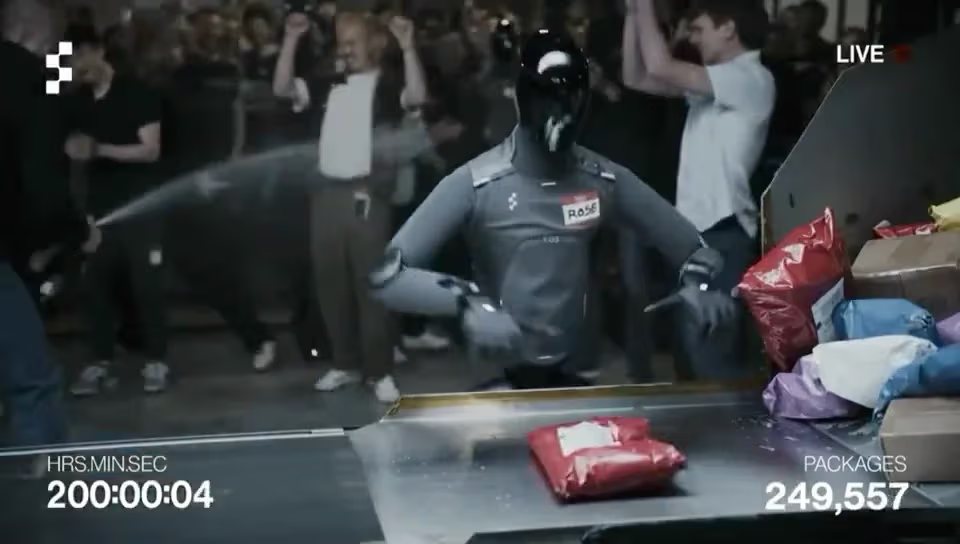
‘Figure’s event began on May 13 as a planned eight-hour robot demonstration featuring the company’s latest Figure 03 robots. The chosen robotic task involved inspecting the bar codes on various small packages—including cardboard boxes and soft padded envelopes or bags—and then placing the packages on a conveyor belt with the bar codes facing downward. The demo would feature the robots performing the task autonomously without any human intervention, according to Figure CEO Brett Adcock.

But Adcock initially played down expectations by noting that the Figure team was aiming for the robots to work for eight hours straight, whereas a previous Figure demo had lasted just one hour. “High odds something breaks,” Adcock posted on X.’

They just ended the demo after the robot worked for 200 hours straight without making a mistake.
https://youtube.com/shorts/P7j65otmBeY?si=W1ea3cjMYYcM6g68

“FM-2030” was an archtranshumanist if there ever was one.
https://en.wikipedia.org/wiki/FM-2030

Screenshot

Thanks to government subsidies and other policies, China’s solar industry surged over the last few years. Most of their output was consumed within China itself, as solar farms were built all over the place. The country’s electrical grid is now glutted with solar power, which is causing problems thanks to its inherent intermittency. Domestic demand will sharply shrink in the near future, leading to a measurable decline in solar power worldwide that critics will surely seize upon as proof the rise of solar power has ended.
https://www.economist.com/china/2026/05/26/chinas-world-beating-solar-industry-is-in-turmoil

The notion that China doesn’t innovate and merely copies Western technology is outmoded.
‘Third, we relate our findings to economic and geopolitical development, arguing that China understands modular natives and scale-up better than any other geography and that this is key to China’s swiftly growing dominance in renewables, batteries, EVs, robots, etc. We argue that China’s mastery of modularity and scale-up is a major innovation in its own right, among the greatest and most impactful in human history, falsifying the common notion that China cannot innovate. Business and government outside China ignore these findings at their peril.’
https://papers.ssrn.com/sol3/papers.cfm

A New Glenn rocket blew up during a test, destroying its launchpad in what might be the biggest non-nuclear explosion in history.

‘The destruction at Cape Canaveral — and the resulting damage to the company’s only launchpad — will likely require months of extensive repairs. Blue Origin was set to launch a key moon mission on its New Glenn rocket this year that will now almost surely be delayed. NASA is trying to build a moon base on Trump’s expedited timeline and beat China to the lunar surface, and this setback could undermine that effort.’
https://www.politico.com/news/2026/05/29/nasa-blue-origin-trump-moon-base-delay-00943139

Accomplished pilot and astronaut Brian Binnie saw UFOs in his backyard one night.
https://www.dailymail.com/news/article-15762377/astronaut-brian-binnie-ufo-encounter-california-bedroom.html

The U.S. government started releasing large numbers of hitherto classified reports about UFO sightings. Most of them are probably explainable, and none of the unexplainable cases are so compelling that they “prove” the existence of alien space ships. Here’s one example.
https://youtu.be/Xn9G1TEEqFE?si=AKNjAdaQlUytJoj1

‘General intelligence explains the link between math and music skills’
https://www.psypost.org/general-intelligence-explains-the-link-between-math-and-music-skills/

Here’s a very fascinating interview with David Reich about what human population genetics tells us about prehistory.
https://youtu.be/Uj6skZIxPuI?si=zXXNSGNni_4uHoJn

During the Bronze Age, when the Great Pyramids were being built in Egypt, Europe and northern Asia were primitive backwaters inhabited by horsemen, hunter-gatherers, and small farming communities. The Indo-Europeans, who resembled today’s white people more than any group at the time, originated in modern Ukraine and spread out in every direction. Some of them–called the “Afanasievo” people–actually reached western China and Mongolia and settled there. Over hundreds of subsequent years, they were absorbed or killed off by East Asians.
https://youtu.be/3dVrVJ_CY4g?si=GsIS1qwySakJPnnn

Conversely, the Indo-Europeans expanded into it and dominated it for thousands of years. Starting around 1000 BC, East Asians from Mongolia started migrating there, and never really stopped. Today, most Kazakhs look partly or fully East Asian. Kazakhstan is within Europe’s boundaries.
https://www.atlasofhumanity.com/kazakh

Genetic studies reveal the identities of some of America’s earliest European colonists who settled in Maryland.
https://blog.23andme.com/articles/ancient-dna-and-the-story-of-some-of-americas-earliest-colonists

‘This means potentially millions of men worldwide have sperm counts so low that their individual spermatozoa are so hard to find that they are considered to be azoospermic. But the power of AI to find these hidden sperm could offer hope to those hoping to become parents.

At the end of last year, after five years in development, the first baby to be born using the Star system allowed a couple who had battled with infertility for almost two decades to finally have a child. It’s a moment Zev Williams, director of Columbia University Fertility Center, and his team remember well.’
https://www.bbc.com/future/article/20260429-finding-hidden-sperm-new-technology-offers-hope-to-men-previously-told-they-were-infertile

The newest GLP-1 drug, “retatrutide”, caused people to lose an average of 28% of their body weight, making it the most powerful weight loss drug yet created.
https://www.scientificamerican.com/article/retatrutide-results-spark-questions-about-how-rapid-weight-loss-affects-the-body/

‘No child deaths definitively linked to Covid shots, FDA says’
https://www.nbcnews.com/health/health-news/no-child-deaths-definitively-linked-covid-shots-fda-says-rcna346514

‘Just a day ago, the brain was in a living person. Now, hours after its owner died, it sits on a cart draped in tubes that quiver as they pump liters of blood substitute and other fluids through the organ, supplying oxygen and removing waste. With most of its key functions intact but its electrical activity quenched by anesthesia, the brain hovers between life and death. As it metabolizes experimental drugs, sensors record its reactions, capturing hundreds of data points on its cells, proteins, and physiology. Then, after 24 hours in this state, it will be sliced into hundreds of pieces for more detailed study.’
https://www.science.org/content/article/not-alive-not-dead-disembodied-human-brains-used-drug-testing

The first “Enhanced Games”–a sports competition without restrictions on performance-enhancing drug use–was held.

‘In the end, across 20 different events, only one world record was set: Kristian Gkolomeev of Greece finished the men’s 50-meter freestyle swim in 20.81 seconds, just barely beating the World Aquatics-recognized world record by .07 seconds.

…Instead, Enhanced had to watch nonenhanced athletes take victory in three different events.

That reminded me of a point Enhanced CEO Max Martin made when I interviewed him back in January: You can take all the performance enhancements you want, and they might make you a better athlete than your nonenhanced self, but you still need athletic skill and genetic luck to be the best in the world.’
https://reason.com/2026/05/26/just-1-world-record-at-the-enhanced-games-shows-the-integrity-of-the-competition/

Human cryonics and the problem of “strategic death”

[Written with the help of GPT-5]

I can’t stop marveling at how smart, capable and creative ChatGPT has become. Regardless of the weirdness of any idea I put forth to it, the machine will dutifully respond will complete seriousness and scholarliness. For people with curious minds, it’s like a drug.

The most interesting recent conversation I had with ChatGPT was about human cryonics: the practice of freezing people right after they die in the hopes doctors will be able to fix them and safely thaw them out in the future. To be clear, the vast majority or perhaps all of the people who have been cryopreserved so far are non-recoverable because they spent too much time decaying before they were frozen or because they were frozen using bad techniques. No level of future technology will ever bring them back.

However, the freezing techniques have been slowly improving, and it’s possible we could find ways to cryopreserve humans without turning their cells into mush, so we shouldn’t write the field off. I took a step farther than that, assumed a way had been found to safely revive people from cryopreservation with their brains USUALLY intact, and started a dialog with ChatGPT. Specifically, I wanted to know about the legal complications arising from revival.

Establishing who the revived person is

The first challenge would be establishing their identity. Future legal systems would likely require multiple independent forms of evidence before recognizing a revived person as the same legal individual who entered cryonic suspension.

The most obvious form of evidence would be biological continuity. DNA samples collected before preservation could be compared with the revived individual. If none existed, then the revived person’s DNA could be compared with any descendants just as paternity tests today prove parentage. Fingerprints, retinal scans, and other biometric records could also be examined.

Yet DNA and biometrics alone would be insufficient. Future medicine will be capable of extensive tissue regeneration, organ replacement, and cellular repair, and those techniques will surely be used on frozen people as part of the revival process, first to fix the freeze-related damage and second to fix whatever injury or illness killed them. As a result person revived after decades or centuries in storage may have a body that differs substantially from the one originally preserved. Fingerprints, scars, and other identifying features may no longer match historical records. Significant reconstruction of the brain would pose special problems for identity verification.

For this reason, biological evidence would be combined with neurological evidence to establish the revived person’s identity. Modern medicine already uses brain imaging technologies to study the structure of the living brain. A future cryonics patient might enter storage with detailed scans of neural architecture, memory centers, and other neurological features. After revival, those scans could be compared with the restored brain. The closer the match, the stronger the evidence for continuity.

Psychological evidence would also play an important role, and, importantly, requires a lower level of technology than high-res brain scans. A revived person could be asked to recall information that was documented before preservation but never publicly released. Personal memories, private experiences, forgotten family details, and other forms of knowledge could be compared against historical records, and perhaps against testimonials the person made in the lead-up to going into cryostasis. A person who accurately recalls thousands of obscure details from a life lived a century earlier would present powerful evidence that continuity of identity has been preserved.

An equally important piece of evidence would be chain of custody. Courts already rely heavily on chain-of-custody procedures when dealing with criminal evidence, human remains, organ transplants, and other sensitive materials. The same principle would be applied to cryonics.

Imagine that a cryonics company maintains continuous records from the moment a patient enters preservation. Every inspection, transfer to a different cooler, maintenance operation, and storage event is documented. The preserved body remains under controlled supervision for a hundred years. When revival finally occurs, investigators can prove exactly where the patient has been and who has been responsible for their care throughout the entire period.

As farfetched as it sounds, a possible future scam could involve cloning a dead person who was in cryostasis, somehow implanting the person’s memories and personality into the clone, and then having the clone claim to be the revived original person. Chain-of-custody requirements would foil such practices.

A future court would probably not rely on any single category of evidence. Instead, it would combine them: DNA would establish biological origin, brain scans and memory/personality tests would establish neurological and psychological continuity, and chain-of-custody records would establish historical continuity. In light of this, it would be very helpful if cryonics companies today required their clients to undergo personality tests, give detailed autobiographical statements, and undergo medical scans that captured their biometrics so those data could be used to help their clients verify their identities in the future after revival. Steps would also be needed to ensure the data’s confidentiality and integrity over the decades or even centuries.

Untangling the revived person’s “past life

After the person is legally confirmed to be the revived dead person, they’ll face a slew of new hurdles that current law is not configured to deal with. Modern law is built on the assumption that death is permanent. Almost every legal consequence that follows from death hinges on the belief that the deceased will never return.

In the U.S., the declaration that a person is dead triggers a cascade of consequences, including estate settlement, termination of legal relationships, and removal from countless government systems. There is currently no established legal procedure for reversing death after, say, a century has passed. The closest modern parallel might be a person who was mistakenly declared dead and later reappears, but even that comparison falls short.

Every practical component of a revived person’s legal identity would have been dormant for many years. Their Social Security records would indicate that they are deceased, their government files would be archived, and many other records would have been transferred between agencies or lost over time. The individual would likely need to petition a court for formal recognition and reconstruct key historical records.

Property presents one of the harshest realities. After death, a person’s assets are distributed according to wills, trusts, probate proceedings, and inheritance laws. By the time a person is revived many years after dying, their former possessions would almost certainly be gone: Their house would have changed owners many times. Their savings would have been spent by descendants generations earlier.

Courts are extraordinarily reluctant to unwind settled property rights, particularly when innocent third parties have relied upon them for decades. As a result, a revived individual would likely discover that they possess no legal claim to any of the wealth they owned before death.

Family relationships would be equally complicated. Marriage legally ends at death, and a surviving spouse becomes a widow or widower and is free to remarry. Those subsequent marriages are fully valid and could not be undone because a dead former spouse reappeared. The revived individual would therefore not automatically regain any marital rights.

Their relationship with descendants would also be unusual: They would remain the biological ancestor of children, grandchildren, and great-grandchildren, yet many of those descendants might be older than they are in biological terms. The law has never had to accommodate family trees in which ancestors routinely outlive their descendants by centuries.

Citizenship and civil status would likely be easier to restore, but they would still require significant administrative effort. Citizenship itself may survive death in a technical sense, but practical recognition of that citizenship does not. A revived person would probably need to obtain new identification documents, reestablish their eligibility for government programs, and restore their presence within systems that had long classified them as deceased. Reapplying for a passport or reactivating a Social Security record might seem minor compared to other legal challenges, but these processes would still require legal recognition that the revived person is who they claim to be.

Contracts, debts, and obligations introduce another layer of complexity. Most contractual relationships terminate upon death. Employment agreements end. Personal obligations are extinguished or settled through the estate. Debts are paid from available assets, discharged, or written off. As a result, a revived person would likely find that old obligations no longer exist. Yet the same principle would apply to rights and benefits. They would not regain employment contracts, pensions, memberships, or other legal relationships that ended upon death. The legal slate would, in many respects, have been wiped clean.

Criminal law raises particularly unusual questions. If a person had committed a crime before death, criminal proceedings would generally have ended once they were declared deceased. A revival many years later would force courts to confront issues for which there is no modern precedent. For most offenses, statutes of limitation would likely prevent prosecution. However, serious crimes like murder that carry no statute of limitations could create difficult legal disputes. Would a prosecution that ended because the defendant died remain permanently closed, or could it be revived along with the defendant? Existing law offers no clear answer.

Even determining the person’s age would become legally ambiguous–If someone died and was cryopreserved at age 80, then thawed out 100 years later, they might be biologically 80 but chronologically 180. Which number should matter? (This sidesteps another complicating issue, biological rejuvenation therapy, which the person probably underwent during the revival process, effectively de-aging their bodies by decades.) Retirement systems, age-based benefits, and countless legal categories assume that biological age and chronological age move together. Cryonic revival would break that assumption. Legislatures and courts would have to decide whether age should be measured by years since birth, years consciously experienced, or some combination of the two. A dual system where different ages are used depending on context is likely.

The most practical future legal solution would be a form of partial continuity. Courts would recognize that the revived individual is indeed the same person who died a century earlier, while simultaneously treating their legal existence as beginning anew at the moment of revival. Revival would be a distinct life event giving rise to new legal personhood, and your previous legal life would be considered “closed.” In effect, the individual would be recognized as the same human being but would need to rebuild much of their legal and economic life from scratch. They would have to establish identity, obtain documentation, and create new financial relationships while accepting that many aspects of their former legal existence had permanently ended.

Dealing with “strategic death”

Another challenge posed by cryonic revival is the possibility that people might deliberately use death for strategic benefit. Modern legal systems assume that death is permanent. As a result, many legal rules treat death as a final endpoint: estates are settled, debts are discharged, insurance benefits are paid, contracts terminate, and criminal proceedings often end. If people can die and later return, those rules create opportunities for exploitation that never existed before.

A future legal system would therefore need to be highly resistant to what might be called “time arbitrage” or “strategic death.” In finance, arbitrage refers to exploiting differences between markets to earn a profit. In the context of cryonic revival, it occurs when someone exploits differences between the legal rules governing the living and the dead in order to gain an advantage that would not be available during a continuous lifetime. They make arrangements to be frozen and revived at some future date and deliberately kill themselves (certainly in a way that doesn’t damage their brain) or stage their death as part of a plan to use “temporary death” as a beneficial legal loophole. Examples are as follows:

  • A heavily indebted person uses a temporary death strategy to allow debts to be settled or discharged through their estate, and then return years later free of financial obligations.
  • Someone buys a large life insurance policy, opts for temporary death, triggers a payout to trusted heirs, and later returns to life to share the wealth generated by their own death.
  • A person who has become rich through asset growth (e.g. – stock or real estate portfolio that massively appreciate over their lifetime) opts for temporary death to take advantage of the U.S. tax code’s “step-up” provision, which waives all capital gains taxes on those assets. After the owner’s death, the assets are transferred to trusted heirs, who liquidate them. The frozen person is then revived, and the untaxed wealth is shared with them.
  • A person facing serious criminal charges or large lawsuits opts for temporary death to escape liability.

The legal system would probably respond to the practice of strategic death with measures like mandatory taxes on revival, limits on pre-death financial structuring, and audits of “revival planning”, especially in cases where the person may be attempting to exploit a loophole. The underlying principle would be simple: no individual should materially gain merely because they passed through legal death and returned.

And while this isn’t a true legal loophole, the practice of using temporary death as a long-term investment strategy could cause enough headaches to warrant legal intervention: A person would place assets into a trust designed to survive for centuries, enter cryonic suspension, and be revived at a prespecified date or under prespecified personal wealth conditions to claim wealth that has massively compounded over time. From their perspective, they would become “instantly rich.” If unchecked, such arrangements could produce vast concentrations of wealth and effectively create immortal financial dynasties.

A future legal system would therefore likely permit long-term trusts while imposing restrictions like duration limits, taxation of dormant assets, and anti-monopoly safeguards designed to prevent extreme accumulation of wealth across centuries. More generally speaking, pre-death financial arrangements would be required to receive heightened scrutiny, particularly if they appeared designed to exploit differences between the legal treatment of the living and the dead.

Dead, alive, and something else

Eventually, the legal system might adapt further by classifying “dead” people differently depending on whether their deceased state were reversible. Biological death and legal death are the same concept today, but in a world with reliable revival techniques, they would diverge. A dead person who was cryopreserved would not be considered permanently dead in the legal sense. Instead, they might occupy a third category between life and death: suspended existence.

Such individuals would remain legally continuous even while inactive. Their obligations could be paused rather than extinguished. Their legal identity would persist. Their eventual return would be anticipated rather than treated as a miracle.

This shift becomes easier to understand when we consider repeated revivals. Suppose a woman is revived after fifty years in cryonic suspension. The event would attract enormous attention. Newspapers would call her a person returned from the dead. Courts would struggle to determine her legal status.

Now suppose the same woman undergoes the process five times over the course of four centuries. At that point, describing her as having “returned from the dead” begins to sound misleading. She is not a resurrected individual, she is simply a very long-lived person who spends portions of her existence inactive.

Eventually society might stop viewing cryonic suspension as death altogether–it would instead be treated as an unusual form of absence. This transformation would fundamentally alter the legal meaning of death.

Today, death is the event that triggers inheritance, dissolves marriages, terminates contracts, and closes a person’s legal existence. In a world where revival is common, those consequences could no longer be tied to biological death alone. They would have to be tied to a determination that the individual is genuinely beyond recovery.

The law would therefore reserve its most serious consequences for a new category: permanent death. On the other hand, a cryopreserved person whose brain remains recoverable, and whose revival remains plausible, would be deemed “suspended.”

The introduction of that third legal category would mitigate temporary death as a means of committing fraud. If an individual deliberately arranged a false death in order to escape criminal prosecution, for example, the law would refuse to recognize any interruption in legal continuity. The person would be treated as having remained legally present the entire time, and prosecution would resume upon their revival. The other loopholes described earlier would likewise be closed.

Conclusion

In the end, the most important legal question raised by cryonics is not whether future technology can revive the dead, but whether our legal institutions can adapt to a world in which death is no longer permanent. Once revival becomes possible, every assumption built into modern law begins to wobble. Courts would need to determine who a revived person is, what rights they retain, what obligations survive, and how to prevent death itself from becoming a tool for fraud, tax avoidance, or other forms of strategic manipulation. Over time, the law would likely be forced to abandon its traditional view of death as a single, irreversible event. Instead, society might come to recognize three distinct states: alive, suspended, and permanently dead. If that transformation occurs, cryonics will not merely have extended human life. It will have compelled civilization to redefine one of its oldest and most fundamental concepts—the boundary between life and death itself.

Interesting articles, April 2026

Israel and America traded more blows with Iran

The sides agreed to a cease-fire, but a permanent peace agreement remains elusive.

An American F-15 was shot down over Iran. After a daring, complex and expensive operation, both pilots were safely recovered.
https://apnews.com/article/iran-us-israel-trump-lebanon-april-5-2026-pilot-cf4a792196259d6e9c066d0be1c57962
https://www.yahoo.com/news/articles/u-military-set-improvised-airfield-181145790.html
https://www.wsj.com/livecoverage/iran-war-latest-news-updates-2026/card/second-mission-to-rescue-u-s-airman-took-155-aircraft-fAUuZAYswIDtWyz1E0hJ

A U.S. A-10 attack jet crashed during the rescue operation.
https://www.ndtv.com/world-news/us-a-10-warthog-fighter-jet-crashes-near-strait-of-hormuz-pilot-rescued-report-11308682

1) Though we have badly damaged Iran’s military while suffering very low losses, the war has been very expensive for us: an alarmingly high fraction of our missiles have been expended. It will take years and many billions of dollars to replace them.

2) Our Gulf allies failed to take basic measures to protect their expensive radar and missile launchers from Iranian attacks.

3) We are short on hardened aircraft shelters at our airbases. They would be cheap to build and would have a large ROI by averting aircraft losses and forcing enemies to use more expensive missiles to strike our planes on the ground.
https://youtu.be/ApIb-nTdoLU?si=H1LXXtLfLrcFGBHQ

If the Persian Gulf oil tanker blockade continues, economies in Europe and especially East Asia will suffer terribly.
https://www.economist.com/finance-and-economics/2026/04/21/global-energy-markets-are-on-the-verge-of-a-disaster

The Ukraine War has attracted considerable numbers of foreign soldiers, including some who claim they were tricked into fighting for Russia.
https://apnews.com/article/cameroon-soldiers-killed-russia-a2a3130018f378b73cc6167918b34b5d

In spite of terrible losses, Russia will probably never run out of tanks in Ukraine. Partly this is because they’re sending fewer into combat given how vulnerable they’ve proven to be.
https://youtu.be/519XMTijfCI?si=ERwfwRkCsNz1neHs

An awesome and historically accurate CGI video of an Argentine fighter plane attack on a British destroyer during the 1982 Falklands War.
https://youtu.be/RNjKfVH6XDI?si=sevEPGhCA3GZ6-av

German “diplomacy” during WWI was terrible.
https://youtu.be/41kYH51XYGw?si=nmyZlog_wI-Lpotc

‘For the first time in a decade, there are no U.S. bases in Syria.’
https://reason.com/2026/04/17/the-u-s-military-has-finally-left-syria/

‘Japan approves scrapping a ban on lethal weapons exports’
https://www.npr.org/2026/04/21/g-s1-118178/japan-ban-lethal-weapons-exports

A company has built a 10-shot crossbow that takes AR-15 accessories.
https://youtu.be/9UxfGf9WQO0?si=8QebSUSPFSp-lMPz

At a half-marathon in China, a robot beat the human record by seven minutes.
https://www.wired.com/story/a-humanoid-robot-set-a-half-marathon-record-in-china/

The AI singer “Eddie Dalton” has several songs on the iTunes Top 100.
https://www.showbiz411.com/2026/04/05/itunes-takeover-by-fake-ai-singer-eddie-dalton-now-occupies-eleven-spots-on-chart-despite-not-being-human-or-real-exclusive

Here’s a great essay about the overlooked benefits of “AI” so far.
https://www.clear-eyed.ai/p/ai-compared-to-what

Demand for AI services has grown so explosively that the tech companies can’t keep up with enough data centers or electricity.
https://www.wsj.com/tech/ai/ai-is-using-so-much-energy-that-computing-firepower-is-running-out-156e5c85

The growth of the data center sector is comparable to rapid buildouts of earlier kinds of infrastructure.

Bill Gates recommends the book The Coming Wave for anyone who wants to glimpse AI’s future impact on the world.
https://www.gatesnotes.com/the-coming-wave

‘According to Anthropic, the capabilities of Mythos are “substantially beyond those of any model we have previously trained”. But the lab says it is particularly alarmed by the system’s ability to find software vulnerabilities and either fix them (if set to work as a defender) or exploit them (if acting as a hacker).

Such claims ought normally to be taken with a pinch of salt. Anthropic built the model, ran the tests—and stands to benefit from the perception that its system is far more brilliant than anything to have come before it. The lab has been on a roll lately. On April 6th it announced that its annualised revenue had reached $30bn, up from just $9bn at the end of last year. It is surely eager to maintain its momentum.

Yet there are reasons to take Anthropic’s latest warnings seriously. The first is their gravity: Anthropic says that Mythos has already found severe vulnerabilities in “every major operating system and web browser”, including one that had gone undetected for 27 years.

The second is the response of other companies. Alongside the pause, Anthropic announced Project Glasswing, an effort to help companies use Mythos to boost cyber-defences before it is widely released. The participation of leading software developers—including Apple, the Linux Foundation and CrowdStrike, as well as Google, which competes directly with Anthropic in AI—suggests the threat is credible.’
https://www.economist.com/business/2026/04/08/how-dangerous-is-mythos-anthropics-new-ai-model

Here’s an excellent and long analysis of where AI technology currently stands and how it will drive geopolitics and the economy. One tidbit:

‘For the last 10 years or so, our geopolitical landscape has been formed more and more by the US-China power competition. Building frontier AI also happens to be so expensive and talent-intensive that only two countries can build it at the frontier.

The boundary conditions for frontier AI are: deep talent pools, massive compute infrastructure, close-to-infinite energy, and capital markets that can finance it. Only the US and China have the economic muscle to spend hundreds of billions of dollars on the computational and energy infrastructure that AI requires. Even if a third player wrote that check, they would still be years behind, because the US and China have been compounding since the beginning.

The result is a simple structure: the two superpowers at the center, each building its own intelligence stack. The US overwhelmingly closed-source, China overwhelmingly open-weight. Around them, a small number of countries that hold critical inputs: lithography in the Netherlands, critical minerals in Australia, energy and capital in the Gulf Countries, fabrication in Taiwan. Two planets and a handful of moons. The moons have leverage because they supply something that cannot be routed around.

Everyone else faces a simpler, less comfortable reality. If you do not control a critical input, you do not have a term sheet. You have a menu. And the menu has two items: rent the intelligence from China, which will come with a certain set of conditions, or rent the intelligence from the United States, which comes with a different set of conditions. Every country will have to go through a sorting function of choosing what they want.’
https://chamath.substack.com/p/2025-annual-letter

‘If recent trends in AI capability growth persist, this pace of AI improvement implies that LLMs will be able to complete most text-related tasks with success rates of, on average, 80%–95% by 2029 at a minimally sufficient quality level. Achieving near-perfect success rates at this quality level or comparable success rates at superior quality would require several additional years. These AI capability improvements would impact the economy and labor market as organizations adopt AI, which could have a substantially longer timeline.’
https://futuretech.mit.edu/publication/crashing-waves-vs-rising-tides-preliminary-findings-on-ai-automation-from-thousands-of-worker-evaluations-of-labor-market-tasks

‘Given the inherent unknowability of this era, what would some of the signs be that we are in it? They might look like this: in 5 years,1) There are high-profile disagreements among leading AI researchers on whether AGI is here. 2) Reputable economists can’t determine if productivity has increased or decreased. 3) Lower public confidence in media platforms and established institutions. 4) The US and China cannot decide whether they are allies nor adversaries. 5) There are ambiguous spikes in employment rates in both directions. 6) Medical levels of anxiety increase. 7) Major court decisions leave as many questions as answers. 8) Commitments (marriage, work) are postponed even later in life. 9) Investing, capital allocation becomes more expensive. 10) Nihilism gets respect.’
https://kevinkelly.substack.com/p/our-uncertain-uncertainties

The Jacquard loom, introduced in France circa 1805, used a chain of punched cards to control which threads were raised for each pass of the shuttle. The ability to change the pattern of the loom’s weave by simply changing cards was an important conceptual precursor to computer programming. Babbage borrowed the idea directly for the Analytical Engine in the 1830s.

The Luddites lost–they were violently suppressed by the UK military–but more generally they lost because programmable looms brought patterned clothes to the masses.
https://marginalrevolution.com/marginalrevolution/2026/04/the-luddites-were-the-first-to-attack-ai.html

Carbon capture programs are failing. ‘So far, various projects in the industry have removed 1.3 million tons of carbon from the atmosphere, according to CDR.fyi. That is a minuscule fraction of the roughly 40 billion metric tons of carbon dioxide that the world emits each year.’
https://www.nytimes.com/2026/04/16/climate/microsoft-carbon-removal.html

Improvements to battery energy density and cost mean that Americans can now buy electric cars for less than $40,000 (the $7,500 federal tax credit no longer exists) that get over 300 miles of range per full charge.
https://www.nytimes.com/2026/04/27/upshot/cheap-electric-cars-gas-prices.html

Last year, an astronomy paper was released documenting apparent UFO sightings from Palomar Observatory in the early 1950s. A new German astronomy paper confirms similar sightings from one of their observatories during the same timeframe.
https://phys.org/news/2026-03-unexplained-sky-1950s-independent-analysis.html

The Artemis II mission flew four U.S. astronauts around the Moon for the first time since 1972. Among them were the first black astronaut, first female, and first Canadian.
https://www.nasa.gov/centers-and-facilities/johnson/artemis-ii-mission-milestones-an-image-and-video-recap/

“I’m not really a religious person but there was no other avenue for me to explain anything or experience anything,” he said.

“So I asked for the chaplain on the Navy ship to just come visit us for a minute. When that man walked in – I’d never met him before in my life – but I saw the cross on his collar and I just broke down in tears.”
https://www.dailymail.com/sciencetech/article-15741363/NASA-astronaut-finds-GOD-returning-Earth.html

The “Black Irish” are erroneously claimed to be the descendants of shipwrecked sailors from the 1588 Spanish Armada who interbred with local people. In fact, the Black Irish are the island’s original inhabitants, and they can trace their lineages back in Ireland to prehistoric times.
https://youtu.be/Y5zUSkqMb7o?si=ir1ePIpx6P6bhsDT

A new study provides the strongest evidence ever of evolutionary pressure in the Near East and Europe as a result of the rise of agriculture starting around 10,000 years ago.
https://www.nature.com/articles/s41586-026-10358-1

A new study shows magic mushrooms are an effective treatment for depression.
https://www.economist.com/science-and-technology/2026/02/19/a-psychedelic-medicine-performs-well-against-depression

Donald Trump has fast-tracked research into hallucinogenic treatments for mental illness.
https://apnews.com/article/ibogaine-psychedelic-trump-fda-ptsd-veterans-kennedy-a9940fa57fa1457fc064eb5165003524

Trump as reclassified marijuana to a lower level of hazard.
https://apnews.com/article/medical-marijuana-rescheduling-justice-department-trump-cannabis-1d6722d3aae122b1a91f8e4b6c690268

The hallucinogen “DMT” is the most effective cure known for cluster headaches. ‘Because DMT is so fast-acting, patients can easily titrate it: take a puff from a vape pen, wait 30 seconds, take another puff — until the attack is gone completely, and before DMT’s psychedelic effects kick in. DMT has a very short half-life of 5–15 minutes, so even if you accidentally overdid it, you’d only need to wait a few minutes for the psychoactive effects to subside.’
https://psychotechnology.substack.com/p/near-instantly-aborting-the-worst

‘Gene therapy for a rare type of deafness shows lasting results’
https://www.npr.org/2026/04/22/nx-s1-5791478/gene-therapy-deafness-hearing

Titan of genetics, J. Craig Venter, is dead at 79.
https://www.jcvi.org/media-center/j-craig-venter-genomics-pioneer-and-founder-jcvi-and-diploid-genomics-inc-dies-79

‘Man Traveled 10,000 Miles and Spent Nearly $40,000 to Cryogenically Freeze His Sick Dog So They Can Reunite in the Future’
https://people.com/australian-man-spent-nearly-40000-dollars-to-cryogenically-freeze-his-sick-dog-11930160

There’s a new human cryopreservation company called “Nectome.”
https://www.lesswrong.com/posts/3i5GMhpGbDwef9Rns/nectome-all-that-i-know

Human lifespan is about 50% heritable, which is more than previously thought.
https://www.science.org/doi/10.1126/science.adz1187

Transgendered people have extremely high rates of mental illness and suicidality. Unfortunately, there’s no evidence that getting sex change operations during their teen years improves their mental health later on.
https://dailydeclaration.org.au/2026/04/07/after-gender-reassignment/

Review: “M3GAN 2.0”

[Written with the help of GPT-5]

Plot:

“She’s back!”

In M3GAN 2.0, the terrifying AI doll returns in a story that leans more into action, humor, and moral ambiguity than the original. The film follows Gemma (played by Allison Williams) as she grapples with the consequences of her earlier creation while navigating a rapidly escalating technological arms race. A new and more dangerous robot—AMELIA—emerges, with her own mysterious agenda, and forcing former enemies into uneasy alignment.

This movie is all about M3GAN’s redemption arc. Instead of being purely a villain, she becomes something closer to an antihero: still sharp-tongued and unsettling, but now positioned as a necessary ally against a greater threat. The dynamic between M3GAN and Gemma drives much of the story, blending tension, dark comedy, and reluctant trust.

The film expands its scope significantly, introducing corporate conspiracies, experimental technologies like brain implants, and high-stakes set pieces ranging from covert infiltrations to chaotic public confrontations. That broader ambition comes with a tradeoff—I didn’t like how this movie’s plot was more convoluted than the first movie’s. There are more moving parts, more characters, and more overlapping agendas, which can make the narrative feel cluttered at times.

Still, I thought the movie was fun and funny and Allison Williams was stunning. The humor lands more often than in the original, and M3GAN’s personality is given more room to shine, especially in her interactions with humans. The film balances its darker sci-fi elements with moments of levity and spectacle, making it an entertaining, if occasionally overcomplicated, continuation of the story.

Analysis:

Though no year is given for the movie’s events, it is clearly set either in the present day or at most five years from now.

Handcuffs won’t work on robots. At the start of the film, the evil gynoid AMELIA is captured by Iranian soldiers who mistakenly believe she is human. They restrain her with standard handcuffs. Once they lower their guard, she easily breaks free by pulling the cuffs apart with her bare hands. This depiction is largely realistic, with an important caveat.

AMELIA

AMELIA is clearly a specialized combat and infiltration machine, like the T-800 from the Terminator films. A robot designed for that role would likely possess strength far beyond human limits, allowing it to break restraints such as handcuffs, zip ties, or even more robust confinement systems intended for people. More broadly, many elements of the built environment that restrict human movement—locked doors, fences, barbed wire, or walls—would not reliably stop such a machine.

Fortunately, this kind of capability would not be typical. Most real-world robots will be task-specific or general-purpose assistants designed to operate safely around humans. That implies limits on strength, speed, weight, and durability, as well as the absence of combat-oriented programming. In other words, AMELIA represents an extreme edge case rather than a baseline for future robotics.

While I am not aware of any current humanoid robot capable of breaking handcuffs, there is no fundamental engineering barrier to building one. The film’s prediction is therefore plausible in principle, even if it reflects a niche category of machines.

Robots will use excessive force to kill humans. AMELIA surprises and attacks her captors, killing one by punching him so hard that his head is severed from his body. While a sufficiently strong machine might be capable of such force, the depiction is unrealistic in how that force is applied.

A system designed for lethal efficiency would not rely on extreme, energy-intensive blows. Instead, it would favor precise, minimal-force strikes to vulnerable areas such as the throat, neck, or head. A metal hand delivering a controlled but targeted impact would be more than sufficient to incapacitate or kill a human, and would do so with far less energy expenditure. As I wrote in my Terminator Salvation review, hand-to-hand combat with killer robots will be brutally skillful and done in seconds.

To the film’s credit, it later presents a more plausible approach. In a subsequent scene, AMELIA disables one FBI agent by striking his windpipe and knocks another unconscious with a controlled punch. This reflects a more realistic model of how an advanced machine might apply calibrated force.

A related scene involves M3GAN defending herself against armed attackers at a gala party event. She uses martial arts techniques to quickly and nonlethally subdue them. This raises an important point about how machines might handle violent encounters. Unlike humans, robots would not experience fear, panic, or hesitation, and they would not depend on imperfect training under stress. As a result, they could consistently apply the minimum force necessary to neutralize a threat.

Humans—especially police—often resort to lethal force in part because of fear, uncertainty, and limited confidence in close-quarters combat. Robots would not share these limitations. Their “lives” would not be at risk in the same way, either because their cognition is backed up remotely or because their bodies are more durable than human ones and immune to punches, knives and even bullets. Even in cases where they are vulnerable, they would not be driven by self-preservation in the same emotional sense. Some might not be programmed to value their own lives.

Because of this, many encounters that humans perceive as life-or-death would not be for machines. Robots could take actions that would be extremely risky for a person, enabling them to resolve dangerous situations with precision and restraint. With appropriate design, this could allow them to reduce the overall level of violence in such encounters.

Finally, since machines will lack emotions (or at least be able to turn their emotions off at will), they won’t be subject to fatigue, stress, anger, or other emotional states that undermine human judgement and training during crises. They will be completely cool and rational in even the most intense confrontations. Instead of robots mass murdering people, we could live in a future where they behave in ways that sharply decrease the number of violent human deaths, worldwide. And for the reasons I’ve mentioned in this section, robots will make better police officers than humans.

There will be brain implants that let people merge minds with other humans and machines. The film introduces a powerful but highly speculative technology in the form of advanced brain implants. Early in the film, an arrogant tech billionaire demonstrates one embedded in his own skull, and late in the film, Allison Williams’ character is forcibly given a similar device.

Allison Williams with a brain implant

These implants are depicted as deeply integrated into the brain, enabling telepathic communication, sensory sharing (e.g. – seeing what the other person’s eyes are seeing), and even remote control of another person’s body. Allison Williams allows this when she needs M3GAN’s fighting skills to beat up enemies. Users can “speak” to one another though internal dialogue, exchange visual perspectives, and override motor functions.

This portrayal is not consistent with the current state of technology or any credible near-term trajectory.

The core difficulty lies in the nature of the brain itself. The brain does not transmit simple, discrete commands that can be easily intercepted and replicated. Instead, it operates through complex, distributed patterns of neural activity that are still not fully understood. Accurately reading intent, translating it into motor output, and maintaining real-time sensory feedback would require breakthroughs across neuroscience, computation, and bioengineering.

There are also major engineering challenges. Current neural interfaces can only interact with a tiny fraction of neurons, signals degrade over time, and biological responses such as scar tissue can interfere with implants. Additionally, spinal and cortical systems are not passive conduits—they actively process and transform signals.

The film also depicts immediate recovery and full functionality after implantation, which is highly unrealistic. Even in a mature version of this technology, such a procedure would likely involve significant medical recovery time, extensive calibration, and a prolonged training period.

Finally, the visual design of the implant—a metallic device protruding from the skull—is implausible from a user-acceptance standpoint. Real-world designs would almost certainly prioritize minimal visibility for aesthetics.

Overall, this is not a near-future technology. It remains speculative and likely requires decades of advancement before anything approaching this functionality becomes possible. As I wrote in my big list of future predictions, I think we’ll have to wait until 2100 for this technology to exist. Furthermore, as I said in my review of “Physics of the Future”, brain implants will not be externally visible and won’t take the form of metallic protuberances coming out of people’s skulls since humans will find that ugly.

Cybernetics will have cured spinal cord damage. The film also presents a dramatic medical breakthrough: the arrogant billionaire stands up from his wheelchair, revealing that cybernetic implants in his spine have restored his mobility.

The arrogant, disabled billionaire

This technology doesn’t exist, nor will it in the near future, so this depiction is incorrect. Moreover, as I’ve said in my big list of future predictions, I don’t think the technology will exist until the 22nd century. ChatGPT explains the formidable hurdles:

The spinal cord is not simply a bundle of wires transmitting signals from the brain to the body. It is a complex processing system that integrates signals, coordinates movement, and manages reflexes. Bypassing a spinal injury would require recreating highly specific patterns of neural activity rather than simply rerouting a signal.

Another major challenge is decoding the brain’s “language” of movement. Motor commands are distributed across large populations of neurons and are continuously adjusted based on sensory feedback. A functional system would need to read these signals, translate them into precise stimulation patterns in the spinal cord, and maintain a real-time feedback loop.

There are also practical limitations. Current electrode technology cannot interface with enough neurons to replicate natural movement, and implants often degrade over time due to biological responses. Additionally, many spinal injuries involve complex damage rather than clean breaks, further complicating intervention.

That said, early experimental systems have shown promise. Some patients have regained limited ability to stand or take assisted steps using brain–spine interfaces. These results demonstrate that the concept is viable, but fully restoring natural, fluid movement remains a long-term challenge.

Terminators will exist. AMELIA is essentially the same thing as a T-800 from the Terminator films–a humanoid machine that looks externally the same as humans but is gifted with superior strength, speed, and fighting skills, and designed to infiltrate human spaces and to destroy targets. M3GAN’s upgraded body is about as capable. While impressive advances in robots have been recently made, we’re still far from being able to make machines that are this sophisticated, so this prediction the movie made will fail. As I’ve said in my reviews of Prometheus and The Terminator, I doubt androids with these constellations of traits will exist until near the end of this century.

AI will help you navigate the world in real time. One of the film’s more grounded ideas appears in a scene where Allison Williams’ character attends a gala while receiving real-time guidance from M3GAN through an earpiece. It presumably has a small microphone that transmits the sound of her own voice. M3GAN can see her surroundings and provide context-sensitive advice, such as warning her about suspicious individuals or suggesting specific actions (e.g. – “Search his pockets for an access card.”). It’s unclear how the visual data is being transmitted, but maybe she is wearing a tiny camera device on her clothing, or M3GAN has hacked into the building’s surveillance camera system.

This depiction is largely accurate as a near-term prediction.

Modern AI systems—particularly large language models—are already capable of providing useful guidance across a wide range of scenarios. The remaining challenge is integration: combining audio input, visual perception, and real-time processing into a seamless, wearable system.

A setup involving an earbud and a camera-equipped smartphone (or similar device) could plausibly achieve this (this was shown in the film Her, in which the main character also wore and earbud and kept a smartphone in his front breast pocket with the camera unobstructed and facing forward). With continued advances in multimodal AI and hardware miniaturization, such systems could become affordable and widely available within the five years.

Exoskeletons will be able to move around on their own. One piece of technology Allison Williams’ company has developed is a powered, full-body exoskeleton for disabled people. It has integral arms and legs connected to a flat torso, and each part tightly mirrors the wearer’s corresponding body part. Early in the film, her male employee puts it on a demonstrates how it works. Around the midpoint of the film, AMELIA seizes control of it remotely and uses it to chase down and attach the company’s female employee.

While there already are exoskeletons for disabled people, they are intended for people with weak or disabled legs and as such only have legs and lack arms. Full-body units meant for people with complete paralysis below the neck don’t exist and almost certainly won’t in the next five years, so this depiction of the present/near future is wrong. However, the film’s underlying logic contains an important insight.

An exoskeleton must be capable of maintaining balance, coordinating movement, and supporting both its own weight and that of its wearer. This implies that, in principle, it should also be capable of operating without a human inside it. In fact, removing the human simplifies the control problem by eliminating unpredictable movements and reducing load.

Additionally, a properly designed exoskeleton would route forces through its own structure rather than through the human body. If the machine lifts a heavy object, the load would be borne by the mechanical frame, not the wearer. (I touched on this in my review of Edge of Tomorrow.)

Given these considerations, it is reasonable to conclude that some future exoskeletons could move autonomously and even be remotely controlled. The film’s depiction is therefore conceptually sound, even if its timeline is optimistic. So, yes, in the future, some kinds of exoskeletons could, by themselves, chase people down and beat them up with their arms. And if they were connected to the Internet, other people or AIs might be able to hijack them and to remotely command them to do the same.

Exoskeletons won’t be waterproof. The characters defeat the hijacked exoskeleton by dumping a fish tank full of water on it, which short-circuits its electronics. This will prove inaccurate.

If exoskeletons are intended for real-world use, they would need to operate in a variety of environments, including exposure to water. Basic waterproofing and environmental sealing are standard engineering practices for modern electronics and machinery. A system as complex and expensive as a full-body exoskeleton would almost certainly be designed to withstand such conditions.

Robots will be able to detect your vital signs by touching you. At the gala party, M3GAN and AMELIA have their first real confrontation. AMELIA kicks Allison Williams hard enough to knock her unconscious and send her skidding across the floor. M3GAN runs to Allison to make sure she’s still alive, and uses her hand to open her eye and to visually scan it, revealing her heart rate, body temperature, and blood oxygen levels. This depiction is partially plausible but flawed in its details.

Allison Williams getting checked out

It is possible to tell heart rate from subtle visual cues, including changes in blood flow visible in the face or eyes, though this requires sensitive instrumentation. However, the eyes do not provide information about body temperature or blood oxygen levels.

A more plausible approach would involve sensors placed on the forehead, particularly over the temporal artery. Heart rate is of course measurable there, infrared thermometers can measure core body temperature from this location, and optical sensors can estimate blood oxygen levels by analyzing light reflected off the skull. These technologies could, in principle, be miniaturized and integrated into a robot’s fingertip, allowing it to gather multiple vital signs through touch.

Of course, no robots have this feature today, nor are they likely to within five years, so the movie’s depiction is wrong. Whatever the case, in the future, I’m sure domestic robots will have the ability to quickly and accurately take vital signs from humans, either thanks to inbuilt sensors or knowledge of how to use basic medical devices.

Robots will entertain you. At the emotional nadir of the film, when all seems lost, Allison Williams and M3GAN are back at their base, alone. As Allison nearly breaks down crying over their predicament, M3GAN first offers consoling words, and then suddenly breaks into a situationally appropriate song–“This Woman’s Work” by Kate Bush. I thought this was hilarious and recommend you watch it to raise your own spirits, and I also think it’s an accurate and surprisingly important depiction of how machines will soon interact with humans.

Anyone who has played around with LLMs knows they’re capable of producing good poetry, funny jokes, understanding countless nuances of the human experience, and rendering good advice on what to do or not to do in specific situations. With entirely reasonable advances in the technology and in the interfaces through which we interact with them (the earbud + forward-facing camera setup I mentioned earlier), it’s likely we’ll have disembodied AIs that can be invisibly present around us at all times and keep us entertained with jokes, songs, or interesting conversation. Five years is a reasonable timeline for such a thing. And there’s no reason to think the companion robots we’ll have in the farther future won’t be endowed with those same attributes.

The implications of this for quality of life for billions of people are profound. Imagine an easing of loneliness, and every day being simply funnier and more entertaining. We’ve been so fixated on the consequences of machines acquiring our job skills and intelligence that we’ve overlooked the upsides of what happens when they’re as funny and as fun as we are.

Interesting articles, March 2026

The U.S. and Israel launched a massive bombing and missile strike campaign against Iran to destroy the latter’s military capacity and nuclear program. Iran has retaliated with waves of missile and drone strikes against Israel, U.S. based, and Arab countries.

Iran’s navy has been practically destroyed.

As was long feared, Iran retaliated by attacking oil tankers in the Persian Gulf, practically closing the waterway to all traffic and spiking global oil prices. In what could be a sign of poor planning, the U.S. lacks enough warships in the region to protect shipping, so President Trump called on allies to send their own ships to do the job. Everyone rejected it.
https://www.reuters.com/business/energy/trump-demands-others-help-secure-strait-hormuz-japan-australia-say-no-plans-send-2026-03-16/

Iran could cause disproportionate damage to the global oil market by mining the waters of the Persian Gulf.
https://www.twz.com/news-features/former-centcom-commanders-candid-take-on-the-situation-in-the-strait-of-hormuz

‘On March 12, a fire broke out in the laundry area of the USS Gerald R. Ford while underway in the Middle East, injuring two sailors. Though officials initially said the damage was minor, the vessel is now heading to Souda Bay in Crete for repairs, according to USNI, taking it out of war against Iran. On Monday, The New York Times reported that the fire took more than 30 hours to extinguish and left more than 600 sailors “bunking down on floors and tables.”’
https://www.twz.com/sea/navy-juggles-its-aircraft-carrier-plans-to-stay-afloat

Though the U.S. has inflicted heavy damage on Iran with very few losses of its own, the war has proven shockingly expensive in terms of money and munitions.

Trump may be preparing to attack Iran with ground troops. Instead of trying to take over the whole country, any invasions will have very limited objectives.

Though America and Israel have badly battered Iran, their objectives and the war’s outcome remain uncertain.

Iran could keep the Strait of Hormuz closed indefinitely if its willing to endure the pain of U.S. retaliation. A massive and very expensive U.S. Navy operation would be needed to protect oil tankers from Iranian attacks.
https://youtu.be/EXkwQOhg9OY?si=e8WmZQp6vcmn9Fvx

The U.S. has been highly effective at hunting down Iran’s ballistic missile launchers thanks to our frighteningly powerful surveillance network.
https://youtu.be/rcAZRtHyNVc?si=JPWCooagKoRVMM5p

A cheap Ukrainian kamikaze drone destroyed an expensive Russian attack helicopter in midair.
https://youtu.be/ot4TA9UR4oY?si=s1GBP8qrdrIN_L3b

3D printed guns keep getting better and cheaper.
https://reason.com/video/2026/03/19/3d-printed-guns-are-getting-good/

The “XM-8” rifle from 20 years ago is back.
https://www.twz.com/land/new-army-6-8mm-carbine-recycles-xm8-designation-from-failed-starship-troopers-rifle-program

Key points of this video:

  • Enormous amounts of AI-generated disinformation about the war have flooded social media and are even being cited by the Iranian government. Truly, we’ve entered the era where you can’t believe what you see.
  • Iran’s drone and missile attacks against so many of its neighbors suggest their command-and-control network has been disabled, and local commanders are using their own (questionable) judgement when picking targets.
  • The U.S. and its allies aren’t in danger of running out of missiles.
    https://youtu.be/mP_rr859r8w?si=6y6i5m8hmc6tVBLj

The Ukraine War has been defined by the rise of combat drones.
https://youtu.be/RXmQIkV3SzU?si=SlbnbcnXHm3qp8CP

The success of the book Shy Girl, which was partly written by an LLM, shows that machines have entered the human range of writing ability.
https://www.nytimes.com/2026/03/19/books/ai-fiction-shy-girl.html

In defense of data centers.
https://reason.com/2026/03/07/the-joys-of-data-centers/

One of the leading tests of machine intelligence, “ARC-AGI-2”, is being gamed by the big tech companies.

‘A simple analogy to understand how devastating this is: imagine you give a math exam to a student, and the format of the questions is red ink on white paper. The student gets a stellar score. But the moment you change it to black ink on white paper, the student freezes and doesn’t know what’s going on.

Wouldn’t that cause you to realize the student doesn’t actually understand the material, and is instead cheating in some way you cannot figure out?’
https://www.reddit.com/r/singularity/comments/1rbw97k/the_arcagi2_illusion_of_progress_if_changing_the/

Because the creators of that test recognized it was being gamed, they just released a new, harder version of it, “ARC-AGI-3.” The lead creator, François Chollet, believes this test will eventually be gamed as well and will lose relevance as a benchmark of general intelligence.
https://www.fastcompany.com/91515360/arc-prize-foundation-new-ai-benchmark

‘Gemini Said They Could Only Be Together if He Killed Himself. Soon, He Was Dead.’
https://www.wsj.com/tech/ai/gemini-ai-wrongful-death-lawsuit-cc46c5f7

‘In private, AI bosses fret about a “Chernobyl moment”, in which the technology is implicated in some sort of deadly or ruinous disaster. The conflict with the defence department heightens the risk: if going slowly and applying limits to the use of your product results in a corporate death sentence from the federal government, only the reckless will survive. The markets are another source of unhelpful pressure: investors are jittery about AI firms burning through cash to make vast investments.

The scenarios keeping AI bosses awake at night are no longer purely hypothetical. “Some of these risks are already materialising, with documented harms,” concluded a recent report on the perils of AI. It pointed to cyber-security and biological weapons as areas where AI’s baleful influence was already apparent.’
https://www.economist.com/briefing/2026/03/05/an-ai-disaster-is-getting-ever-closer

‘TL;DR: ChatGPT 5.4 is a real upgrade from 5.2. Stronger analytical work, better spreadsheets, and extended thinking that’s impressive under the hood. But the writing is still flat compared to Claude, the finished output doesn’t match the quality of its own reasoning, and you have to over-prompt to get what you want. If you’re productive with Claude or Gemini, don’t switch. If you’re on OpenAI, enjoy the upgrade.’
https://www.smithstephen.com/p/chatgpt-54-is-good-thats-not-the

OpenAI has discontinued its video generator “Sora” after just a few months, ostensibly because it was unprofitable.
https://www.cnn.com/2026/03/24/tech/openai-sora-video-app-shutting-down

Another take on why Sora was ended and why it means OpenAI is probably planning to go public and issue stock this year.
https://x.com/aakashgupta/status/2037380094596100364

After Anthropic refused to let the Department of War use its AI systems for mass surveillance and autonomous weapons, the Trump administration started trying to force the company to comply.
https://youtu.be/KBPOTklFTiU?si=qPiO0gzUVcNSxqHE

Here’s an interesting interview with tech industry analyst Dylan Patel. Some of his insights and predictions I found interesting are:

  1. A key bottleneck in the AI race is the supply of microchips. The high-end GPUs that are used in data centers are the cutting edge of computer hardware, and the fabrication labs that make them are too few in number to accommodate the growth in demand. TSMC owns most of the fabs and has been reluctant to expand its capacity out of fear the AI bubble might burst, saddling it with a bunch of excess production capacity.
  2. China is significantly behind the U.S. and Taiwan with respect to cutting-edge GPU production. China can and will massively scale up the quality and quantity of its own GPU manufacturing but will still probably lag the West in 10 years.
  3. In defiance of what Moore’s Law has accustomed us to for decades, the prices of smartphones and personal computers will INCREASE for the next several years as data centers gobble up the world’s supply of RAM.
  4. Earth will eventually get so clogged with data centers that it will make financial sense to put them in space. However, it definitely won’t start this decade.

Remarkably, Elon Musk’s plan to start building a Dyson Swarm is not infeasible. The key hurdle to surmount will be sharply lowering space launch costs, which Musk’s Starship rocket might soon be able to do.
https://www.economist.com/science-and-technology/2026/03/02/data-centres-in-space-less-crazy-than-you-think

At this conference among physicists about the future applications of AI in their field, one speaker made two, great points:

  1. Machines are getting smarter every day. By contrast, human intelligence is not changing. At some point, the two lines on the graph will cross.
  2. If the long-sought “Theory of Everything” exists, it might be too complex for the human mind to comprehend. However, to vastly smarter AIs, such a Theory would be simple and elegant. There’s no reason to assume the physical rules of our universe are tuned for easy human understanding.
    https://physicsworld.com/a/is-vibe-physics-the-future/

Boston Dynamics’ “Atlas” robot shows off its extreme dexterity. It’s weird seeing a human-like form capable of inhuman movements.
https://youtube.com/shorts/-EJXWjMjLYk?si=PWbHEIX2wq92I2yF

‘First Lady Melania Trump walks with robot to White House event on children’s technology’
https://youtu.be/7sHSBgU5p4Y?si=nCVy6UxkHDE1c4uc

One gigawatt of electricity can power about 700,000 American homes.

Paul Ehrlich, an American scientist who became infamous for his failed prediction that overpopulation would lead to global famine in the 1970s, died of natural causes.
https://www.nytimes.com/2026/03/15/books/paul-r-ehrlich-dead.html

‘The AI scientists building these models are experts on machine learning and AI, but they are much less familiar (as evidenced by their own publications) with molecular biology and genetics. So it is likely that they believe their own claims, and they might not understand how implausible they are.’
https://stevensalzberg.substack.com/p/ai-is-starting-to-look-like-pseudoscience

‘Scientists revive activity in frozen mouse brains for the first time’
https://www.nature.com/articles/d41586-026-00756-w

A company’s claims that they accurately simulated a fly’s brain in a computer have come under fire.
https://x.com/KennethHayworth/status/2032604687212392562

Personal AIs and robots probably won’t make the world more equal

The head of OpenAI, Sam Altman, recently made this prediction:

Fundamentally our business, and I think the business of every other model provider, is going to look like selling tokens. You know, they may come from bigger or smaller models, which makes them more or less expensive. They may use more or less reasoning, which also makes them more or less expensive. They may be running all the time in the background trying to help you out, they may run only when you need them if you want to pay less. They may work super hard, you know, spend tens of millions, hundreds of millions, of someday billions of dollars on a single problem, that’s really valuable.

But we see a future where intelligence is a utility like electricity or water, and people buy it from us on a meter and use it for whatever they want to use it for.

I agree with his prediction and want to share my thoughts on what it means for individuals, society and the economy, and to unpack some key assumptions behind Altman’s statement.

“Fundamentally our business, and I think the business of every other model provider, is going to look like selling tokens.”

The phrase “is going to be” means he’s speaking about the future. This means Altman foresees most people getting AI services remotely from large tech companies like OpenAI, and not in-house from personal computing devices they own and keep in their houses or pockets. I agree this will be true, though improvements to the price-performance of LLMs and an eventual drop in the prices of GPUs and RAM as supply expands will someday make it feasible for average people to host AIs on their own hardware.

However, it will remain more convenient and probably cheaper to access LLMs over the internet from companies like OpenAI. Additionally, thanks to having better hardware and more of it, and more advanced models, the companies will always have a monopoly over the fastest and smartest AIs. For those reasons, access to AI will stay under the central control of a handful of big companies and government agencies with the resources to build data centers and to do cutting-edge AI research.

“You know, they may come from bigger or smaller models, which makes them more or less expensive. They may use more or less reasoning, which also makes them more or less expensive. They may be running all the time in the background trying to help you out, they may run only when you need them if you want to pay less.”

Access to AI will be tiered and principally based on how much money the user is willing to spend. As is the case today, different AI models will have different levels of capability, and it will cost more money to talk to better ones. As a result, though everyone in the future will have access to AIs, not all AIs will be equal, and the rich will have the best.

“They may work super hard, you know, spend tens of millions, hundreds of millions, of someday billions of dollars on a single problem, that’s really valuable.”

This is an important point. Not every question or task that humans put before an AI is equally hard for it to handle. Asking one to summarize a news article is easier than asking it to make a new discovery in particle physics. A “dumber” AI with only a slower and cheaper processor could handle the former perfectly well, whereas only a cutting-edge AI with a data center at its command could do the latter.

If true AI were available, the vast majority of people would not use it to attempt solving high-level problems that cost millions of dollars to solve–they would use it to meet their everyday needs. This includes things like soliciting advice on routine things like cooking new meal recipes, remembering chores, and making conversation. If endowed with a robot body, most people would have their AIs do mundane work like cooking or cleaning.

Today, the world’s best supercomputer can’t beat a smart nine-year-old kid at tic-tac-toe; the two will tie each other forever. This is because the game is so simple that beyond a certain threshold, adding more brainpower doesn’t help you come up with a better strategy for it. Likewise, we’ll reach a point where nearly all needs that average people have can be sated by AIs and robots that are not cutting-edge.

There is a ceiling to the level of intelligence an AI must have to perform cognitive tasks as well as humans, and a ceiling to how well a robot must be engineered to perform the physical tasks as well as humans. Once those respective ceilings are reached, the vast majority of human demands for cognitive and physical services will be met, yet the fields of AI and robotics will continue advancing. As the cost-performance of technology improves, the prices of AIs and robots designed to satisfy routine human needs will drop until everyone can easily afford them.

We will all have machine servants that can answer every question, provide us with true companionship, and do physical work for us around the house. Today, only the rich enjoy such services, but this century it will become common for everyone, and stand as another example of technology raising the standard of living. As wonderful and this sounds, it will not be a utopia, nor will it necessarily make the world more equal for humans. Rich individuals, corporations and governments will be able to afford access to more advanced AIs and robots and more of them than ordinary people. The disparity will grow when mass unemployment robs most people of their income and leaves them with only enough money (from UBI?) for the machines calibrated to not surpass what is needed to satisfy everyday needs (cognitive, physical, emotional).

For those reasons, AI technology will not be truly democratizing. Ordinary people will have access to tools of enormous power, allowing them to do things previously impossible, but that access will be controlled by large companies and entities. Additionally, the best AIs will also be too expensive for ordinary people to afford, meaning richer people and organizations will enjoy major advantages as they do now.

Consider the realm of economics. Let’s say it’s 2046 and I have a robot butler that can do any physical task as well as a human. I am enterprising, so I decide to start renting my robot out to mow peoples’ lawns in my neighborhood. After all, it’s a capital good, and I’m a capitalist. My business plan isn’t as solid as it seems.

Problem #1: Since robots have gotten cheap enough for anyone to afford, most of my neighbors already have their own, so their lawns are already being mowed.

Problem #2: The RoboChop Lawn Care company offers grass-cutting services in my neighborhood, does it faster and charges less money than I do. That’s because they have robots that are specialized for cutting grass and nothing else. One of their wedge-shaped, coffee-table sized robots with four wheels and an inbuilt rotating blade can zip along four times faster than my robot butler can walk while pushing a traditional lawn mower. And since RoboChop ONLY mows laws and its robot crew does multiple jobs per day, the company can offer volume discounts for its services that I can’t.

Even though I have a robot and access to AI, I’m still so outclassed in the market by bigger competitors that there’s no niche where I can succeed. At first glance, this clashes with my essay “Will future technologies end capitalism? No.”, but the key ideas are in fact in harmony: Yes, the future economy will still be capitalist, and arguably more so than now since most humans will have easy-to-use capital goods (AI and robots), but the resource disparity between average people and businesses will be so large that the former won’t be able to participate in that capitalist economy. A rising tide will lift all boats, but some much more than others.

Interesting articles, February 2026

The U.S. and Israel have assembled a massive air and naval strike force in the Middle East and have attacked Iran. The fighting is ongoing as of this writing.
https://www.cnn.com/world/live-news/israel-iran-attack-02-28-26-hnk-intl
https://www.twz.com/news-features/final-pieces-moving-into-place-for-potential-attack-on-iran
https://www.wsj.com/world/middle-east/in-a-first-u-s-deploys-combat-jets-to-israel-for-potential-wartime-mission-in-iran-c739d870

Here’s incredible footage of an intercepted Iranian missile crashing to the ground in Qatar.
https://youtu.be/VDk5cPwTPKY?si=M5yNX_1UMz4BsMeW

‘Iran strikes threaten to deplete US weapons supplies — and put American troops at risk’
https://www.politico.com/news/2026/02/25/iran-weapons-trump-troops-defense-00797801

Colombia has a large population of recently discharged soldiers who have become mercenaries in Ukraine and other conflict zones because they can’t find jobs at home.
https://www.economist.com/the-americas/2026/02/04/why-so-many-colombians-fight-in-foreign-wars

‘Russia killed opposition leader Alexei Navalny using dart frog toxin, UK says’
https://www.bbc.com/news/articles/cwyk4lz4e3eo

A Norwegian scientist built one of the hypothesized microwave weapons responsible for “Havana syndrome,” fired it at his head, and now has the syndrome. The U.S. government also secretly bought a similar microwave weapon on the black market from an undisclosed country and found Russian components inside of it.
https://www.washingtonpost.com/national-security/2026/02/14/havana-syndrome-cia-norway-experiment/

The expiration of the New START treaty between Russia and America will free the U.S. to quickly beef up its nuclear arsenal.
https://www.twz.com/air/usaf-ready-to-make-all-b-52s-nuclear-capable-load-icbms-with-multiple-warheads-if-directed

One reason the U.S. has so many nuclear weapons is it must be prepared for a war where Russia and China are both against us, and our allies offer little help. Now that China is expanding its nuclear arsenal, the U.S. will need to do the same. The 40-year trend of nuclear disarmament is over.
https://www.economist.com/international/2026/02/03/america-risks-a-nuclear-arms-race-with-china

Russia is using an intermediate-range ballistic missile against Ukraine that it illegally developed 10 years ago. During his first term, Trump withdrew the U.S. from the Intermediate-Range Nuclear Forces (INF) Treaty because U.S. intelligence had discovered Russia had the treaty-banned missile. It can carry conventional or nuclear warheads.
https://www.reuters.com/business/aerospace-defense/ukraine-images-indicate-russia-used-missile-heart-nuclear-pact-collapse-2026-02-26/

Early Soviet warships were low-tech and full of design flaws.
https://youtu.be/1CWLrpYGKVE?si=v_MxRhIH1iF8J_kc

A Chinese video generator has made waves after it was used to make a real-looking CGI clip of Tom Cruise and Brad Pitt fighting in a movie. It’s yet another milestone on the road to personalized entertainment content.
https://www.hollywoodreporter.com/business/business-news/mpa-cease-and-desist-bytedance-seedance-2-0-1236510957/

Here’s an incredible Seedance 2 CGI video of Neo and Agent Smith fighting.
https://youtu.be/c00ZNn9v01o?si=UIBMePPDAzSeuplM

Elon Musk is in legal trouble in France for allowing Grok to undress images of people (mostly women).
https://apnews.com/article/france-x-investigation-seach-elon-musk-1116be84d84201011219086ecfd4e0bc

‘It is impossible to draw meaningful conclusions from METR’s Long Tasks benchmark — in particular once one realizes that its numerous flaws are probably compounding in unpredictable ways.’
https://www.transformernews.ai/p/against-the-metr-graph-coding-capabilities-software-jobs-task-ai

A few X posts about AI:

McKinsey agrees with me that AI will make capitalism more efficient and cutthroat than ever.
https://www.mckinsey.com/capabilities/quantumblack/our-insights/the-automation-curve-in-agentic-commerce

The Atlas robot can now do somersaults. I like that they showed some of the outtakes.
https://youtu.be/UNorxwlZlFk?si=MFEt7uM72a4iU1Ik

“An LLM-controlled robot dog saw us press its shutdown button, and the LLM rewrote the robot’s code so it could stay on.”
https://palisaderesearch.org/blog/shutdown-resistance-on-robots

The 2026 Spring Festival Gala by China Media Group featured an incredible, choreographed robot dance performance.
https://youtu.be/mUmlv814aJo?si=37YQ1QT8YhE5_B_g

Rodney Brooks issues his yearly technology predictions. He says LLMs will not lead to AGI, and that the LLM era of what I call “Fake AI” will last at least 10 more years. Also, humanoid robots have also been oversold the the media and are still too dangerous and limited for use in the real world.
https://rodneybrooks.com/predictions-scorecard-2026-january-01/

‘Amazon shelves Blue Jay warehouse robot’
https://www.foxnews.com/tech/amazon-shelves-blue-jay-warehouse-robot

Twitter founder Jack Dorsey just laid off 40% of his staff at his new tech company, “Block,” because AI made them redundant.
https://apnews.com/article/block-dorsey-layoffs-ai-jobs-18e00a0b278977b0a87893f55e3db7bb

The “AI 2027” report was published last April and predicted AGI would be created by 2028. Now that a whole nine months have passed, the authors have been able to compare actual tech developments with what they predicted, and unsurprisingly, things are moving slower than they hoped, so they have bumped their date for the rise of AGI to “mid-2028 to mid-2030.” I think it’s wise to accept the upper bound.

I wonder if, after another nine months of slower-than-hoped tech progress, they will push back their big prediction again. Ultimately, and in spite of its apparently rigorous methodology, the “AI 2027” report might turn out to have been useless.
https://blog.ai-futures.org/p/grading-ai-2027s-2025-predictions

A wonderful essay that contains ideas I’ve written about on this blog: “Post-AGI Economics As If Nothing Ever Happens”
https://www.lesswrong.com/posts/fL7g3fuMQLssbHd6Y/post-agi-economics-as-if-nothing-ever-happens

This essay, “The 2028 Global Intelligence Crisis”, predicted dire economic impacts from AI by 2028, and actually caused a measurable drop in global stock markets. It’s funny because all of the essay’s core ideas are predictions I made years ago, and shared here. If only more people listened to me!
https://www.citriniresearch.com/p/2028gic

Here’s are two counterpoints to the essay:
https://marginalrevolution.com/marginalrevolution/2026/02/is-there-an-aggregate-demand-problem-in-an-agi-world.html
https://www.economist.com/finance-and-economics/2026/02/25/a-viral-research-note-on-ai-gets-its-economics-wrong

Sam Altman made a controversial yet entirely factual statement that downplayed the energy requirements of data centers by pointing out the vast energy required to support one human into adulthood. This is a very good point. As Noam Chomsky famously observed and other scientists expanded upon, the human brain comes hardwired with many algorithms for intelligent thinking that only came into existence over tens of millennia of evolution. In fact, it probably actually the product of millions of years of evolution that began with our pre-human ancestors first diverging from other mammals.
https://www.facebook.com/reel/931074852795152

Elon Musk is making huge, risky bets on household robots, autonomous taxis, near-term sharp improvement in AI, and data centers in space. He’s having to marshal all of his already vast resources to give it a shot.
https://www.economist.com/business/2026/02/04/elon-musk-is-betting-his-business-empire-on-ai

Anthropic is refusing the Department of War’s demand to let it use its AI systems for mass surveillance and autonomous weapons. I like how the head of the company acknowledges that the U.S. will SOMEDAY need a fully autonomous army to defend itself. As in every other realm of endeavor (business, art, whatever), AGI and robots will render humans obsolete, and any organization that wants to stay competitive will need to switch to machines. His important caveat is that the machines aren’t smart enough to do it yet, and so can’t be trusted.

‘Partially autonomous weapons, like those used today in Ukraine, are vital to the defense of democracy. Even fully autonomous weapons (those that take humans out of the loop entirely and automate selecting and engaging targets) may prove critical for our national defense. But today, frontier AI systems are simply not reliable enough to power fully autonomous weapons.’
https://www.anthropic.com/news/statement-department-of-war

‘Pennsylvania State Police were stymied in their investigation into the violent rape of a woman in 2016 on a remote cul-de-sac outside Milton, a small community in the center of the state. With no clear leads, police obtained a warrant directing Google to disclose accounts that searched for the victim’s name or address over the week when she was attacked.’
https://apnews.com/article/google-reverse-keyword-search-privacy-c5a0bc6f3790213f92e78aae720d2379

‘Women were significantly more likely to focus on areas where danger could lurk, including unlit areas, potential hiding spots and places where they might be trapped, often off to the side of their path.’
https://www.deseret.com/2024/2/7/24065126/byu-study-gender-difference-night-time-walking-jogging-vigilance/

‘There is an unfortunate bias against attractive people. It stems from the belief that their looks allow them to glide through life and provides them with opportunities that average-looking people don’t have. The doctors I knew were always curious when meeting a good-looking sales rep: Is there any substance behind the pretty face?’
https://medicalsalestraining.com/the-risk-and-myth-of-the-good-looking-sales-rep-in-medical-sales/

More evidence that marijuana inflames some kinds of latent mental illnesses.
https://www.npr.org/2026/02/21/nx-s1-5719338/cannabis-marijuana-weed-teens-psychosis-jama

A small advance towards being able to freeze and thaw out human brains without destroying them has been made.
https://www.biorxiv.org/content/10.64898/2026.01.28.702375v1

Musings 11

An AGI Dyson Swarm will have problems synchronizing its satellites thanks to light speed latency, and this will have major implications for its intelligence and consciousness. A Dyson Swarm is a vast cloud of solar-powered satellites that surround a star in a spherical formation. Each satellite converts light into electricity and then uses it for various tasks. Doubtless, a Swarm would be comprised of many types of satellites that are specialized for different functions, like data processing, communications, or manufacturing space ships. The radius of the Swarm would need to be enormous since the satellites would melt or at least run inefficiently if too close to the star. A radius equal to the Earth’s distance from the Sun, 1 astronomical unit (AU), isn’t unreasonable.

The satellites responsible for data processing will be distributed and will need to communicate with each other, just as the neurons in your brain need to send electrochemical signals to their neighbors to collectively produce intelligent thought. However, if the Swarm has a 1 AU radius, then it will take 17 minutes for a light-speed signal to travel from one end of it to the other, plus another 17 minutes to get any response. While acknowledging the existence of lag within the human brain (e.g. – scientists have measured how long it takes for signals to travel across the brain, and you instinctively understand that it takes time to think to arrive at a solution to a problem), this will be much different: Consider what the processing speeds will be on the futuristic computers emplaced in each satellite. Each computer will be “thinking” so fast that their subjective experience of time will probably be more drawn-out than it is for humans, making a 17-minute communication lag feel like an eternity.

It occurs to me that this discordance would either prevent a Dyson Swarm from having a unitary, coherent consciousness, or give rise to a consciousness that would be very alien from our own (this compounds upon whatever fundamental alienness there is to machine consciousness compared to human). In the former case, it would ensure the Dyson Swarm were comprised of many AGI individuals.

A future step in tech-enhanced human evolution will be dividing our consciousnesses into many directions at once, in turn allowing one person to control multiple bodies simultaneously. One consequence of this is that you’d be able to have sex with yourself.

Autonomous cars will help people easily earn side cash delivering packages. Right after you get into a car and enter your destination, the car’s computer will be able to determine if anyone needs a package delivered from one point to another along your intended route. It would instantly tell you if there were any opportunities to transport packages (or people) for profit and let you decide whether it was worth it. 

There will also be autonomous cars not designed to carry humans. For example, imagine something smaller than a SmartCar that lacks a steering wheel or seats and is solely designed to deliver food. It might just have one or two little doors that would pop open so a customer could reach inside to get their order.

Thanks to better reaction speeds, machines will be able to drive cars safely under conditions that many humans couldn’t handle. For example, autonomous cars could drive at high speeds while separated from each other by only a few feet. They would coordinate their movements so none of them changed velocity without giving the others time to react. This would allow vehicles to pack together more densely, effectively increasing the capacities of existing roadways.

The losers of the autonomous car revolution include:

  1. Car insurance companies. Fewer accidents means less need for insurance. The industry will be forced to consolidate and to focus more on selling other products, like homeowners insurance (though if everyone also has a robot butler that can put out fires and fix major plumbing leaks, demand for that type of insurance also drops).
  2. Traffic police
  3. Local governments that get revenue from red light cameras, speed cameras, and ticketing drivers for infractions.  
  4. Home movers. In the future, you might pay some local guys off Craigslist to load your furniture and other belongings into an autonomous truck, then it would drive itself to the destination, where you’d pay a second group of local guys to unload it. Moving a full house worth of stuff halfway across America can easily cost $10,000 today. The system I described might cut that down by 70-80%. 
  5. The car moving industry (e.g. – someone else drives your car across country for you because you moved) will also die out once cars are autonomous.
  6. Owners of large parking lots, particularly around airports.

If intelligent aliens are visiting Earth, one way they would monitor us is with machines that are the size and shape of insects. It might be that there’s an alien database of DNA from every human who has ever lived, compiled thanks to billions of robot mosquitoes sucking blood from people while they slept. Maybe they’ve got DNA from a beloved pet you had as a child. And depending on how long the aliens have been here, there might even be samples of DNA from extinct species like dinosaurs.

If, generally speaking, consumer technologies and AI will increasingly focus on satisfying individual preferences (e.g. – virtual reality game where you’re the only player and you’re always #1), then why should it extend to the foods and drinks you consume? Continuous surveillance will allow your personal assistant AI to quickly learn your food and drink preferences. Once robot chefs are everywhere, you’ll be able to have your exact favorite meal or sandwich you remember from your childhood anytime. Even if you went into a restaurant or someone else’s house, it would be a simple matter for you to transmit your recipe to the robot chef who was there and have it make something for you, perfectly.

A small step towards this future can be seen in the newer restaurant soda machines that can mix dozens of syrups to make hundreds of kinds of drinks.

With better knowledge of how the human flavor palate works (there is probably some genetic component to this), machines could go a step farther by tweaking your favorite recipes in ways that will make them taste even better, and by recommending new foods and drinks you wouldn’t have tried but will probably love.