
Interesting articles, April 2026

Israel and America traded more blows with Iran

The sides agreed to a cease-fire, but a permanent peace agreement remains elusive.

An American F-15 was shot down over Iran. After a daring, complex and expensive operation, both pilots were safely recovered.
https://apnews.com/article/iran-us-israel-trump-lebanon-april-5-2026-pilot-cf4a792196259d6e9c066d0be1c57962
https://www.yahoo.com/news/articles/u-military-set-improvised-airfield-181145790.html
https://www.wsj.com/livecoverage/iran-war-latest-news-updates-2026/card/second-mission-to-rescue-u-s-airman-took-155-aircraft-fAUuZAYswIDtWyz1E0hJ

A U.S. A-10 attack jet crashed during the rescue operation.
https://www.ndtv.com/world-news/us-a-10-warthog-fighter-jet-crashes-near-strait-of-hormuz-pilot-rescued-report-11308682

1) Though we have badly damaged Iran’s military while suffering very low losses, the war has been very expensive for us: an alarmingly high fraction of our missiles have been expended. It will take years and many billions of dollars to replace them.

2) Our Gulf allies failed to take basic measures to protect their expensive radar and missile launchers from Iranian attacks.

3) We are short on hardened aircraft shelters at our airbases. They would be cheap to build and would have a large ROI by averting aircraft losses and forcing enemies to use more expensive missiles to strike our planes on the ground.
https://youtu.be/ApIb-nTdoLU?si=H1LXXtLfLrcFGBHQ

If the Persian Gulf oil tanker blockade continues, economies in Europe and especially East Asia will suffer terribly.
https://www.economist.com/finance-and-economics/2026/04/21/global-energy-markets-are-on-the-verge-of-a-disaster

The Ukraine War has attracted considerable numbers of foreign soldiers, including some who claim they were tricked into fighting for Russia.
https://apnews.com/article/cameroon-soldiers-killed-russia-a2a3130018f378b73cc6167918b34b5d

In spite of terrible losses, Russia will probably never run out of tanks in Ukraine. Partly this is because they’re sending fewer into combat given how vulnerable they’ve proven to be.
https://youtu.be/519XMTijfCI?si=ERwfwRkCsNz1neHs

An awesome and historically accurate CGI video of an Argentine fighter plane attack on a British destroyer during the 1982 Falklands War.
https://youtu.be/RNjKfVH6XDI?si=sevEPGhCA3GZ6-av

German “diplomacy” during WWI was terrible.
https://youtu.be/41kYH51XYGw?si=nmyZlog_wI-Lpotc

‘For the first time in a decade, there are no U.S. bases in Syria.’
https://reason.com/2026/04/17/the-u-s-military-has-finally-left-syria/

‘Japan approves scrapping a ban on lethal weapons exports’
https://www.npr.org/2026/04/21/g-s1-118178/japan-ban-lethal-weapons-exports

A company has built a 10-shot crossbow that takes AR-15 accessories.
https://youtu.be/9UxfGf9WQO0?si=8QebSUSPFSp-lMPz

At a half-marathon in China, a robot beat the human record by seven minutes.
https://www.wired.com/story/a-humanoid-robot-set-a-half-marathon-record-in-china/

The AI singer “Eddie Dalton” has several songs on the iTunes Top 100.
https://www.showbiz411.com/2026/04/05/itunes-takeover-by-fake-ai-singer-eddie-dalton-now-occupies-eleven-spots-on-chart-despite-not-being-human-or-real-exclusive

Here’s a great essay about the overlooked benefits of “AI” so far.
https://www.clear-eyed.ai/p/ai-compared-to-what

Demand for AI services has grown so explosively that the tech companies can’t keep up with enough data centers or electricity.
https://www.wsj.com/tech/ai/ai-is-using-so-much-energy-that-computing-firepower-is-running-out-156e5c85

The growth of the data center sector is comparable to rapid buildouts of earlier kinds of infrastructure.

Bill Gates recommends the book The Coming Wave for anyone who wants to glimpse AI’s future impact on the world.
https://www.gatesnotes.com/the-coming-wave

‘According to Anthropic, the capabilities of Mythos are “substantially beyond those of any model we have previously trained”. But the lab says it is particularly alarmed by the system’s ability to find software vulnerabilities and either fix them (if set to work as a defender) or exploit them (if acting as a hacker).

Such claims ought normally to be taken with a pinch of salt. Anthropic built the model, ran the tests—and stands to benefit from the perception that its system is far more brilliant than anything to have come before it. The lab has been on a roll lately. On April 6th it announced that its annualised revenue had reached $30bn, up from just $9bn at the end of last year. It is surely eager to maintain its momentum.

Yet there are reasons to take Anthropic’s latest warnings seriously. The first is their gravity: Anthropic says that Mythos has already found severe vulnerabilities in “every major operating system and web browser”, including one that had gone undetected for 27 years.

The second is the response of other companies. Alongside the pause, Anthropic announced Project Glasswing, an effort to help companies use Mythos to boost cyber-defences before it is widely released. The participation of leading software developers—including Apple, the Linux Foundation and CrowdStrike, as well as Google, which competes directly with Anthropic in AI—suggests the threat is credible.’
https://www.economist.com/business/2026/04/08/how-dangerous-is-mythos-anthropics-new-ai-model

Here’s an excellent and long analysis of where AI technology currently stands and how it will drive geopolitics and the economy. One tidbit:

‘For the last 10 years or so, our geopolitical landscape has been formed more and more by the US-China power competition. Building frontier AI also happens to be so expensive and talent-intensive that only two countries can build it at the frontier.

The boundary conditions for frontier AI are: deep talent pools, massive compute infrastructure, close-to-infinite energy, and capital markets that can finance it. Only the US and China have the economic muscle to spend hundreds of billions of dollars on the computational and energy infrastructure that AI requires. Even if a third player wrote that check, they would still be years behind, because the US and China have been compounding since the beginning.

The result is a simple structure: the two superpowers at the center, each building its own intelligence stack. The US overwhelmingly closed-source, China overwhelmingly open-weight. Around them, a small number of countries that hold critical inputs: lithography in the Netherlands, critical minerals in Australia, energy and capital in the Gulf Countries, fabrication in Taiwan. Two planets and a handful of moons. The moons have leverage because they supply something that cannot be routed around.

Everyone else faces a simpler, less comfortable reality. If you do not control a critical input, you do not have a term sheet. You have a menu. And the menu has two items: rent the intelligence from China, which will come with a certain set of conditions, or rent the intelligence from the United States, which comes with a different set of conditions. Every country will have to go through a sorting function of choosing what they want.’
https://chamath.substack.com/p/2025-annual-letter

‘If recent trends in AI capability growth persist, this pace of AI improvement implies that LLMs will be able to complete most text-related tasks with success rates of, on average, 80%–95% by 2029 at a minimally sufficient quality level. Achieving near-perfect success rates at this quality level or comparable success rates at superior quality would require several additional years. These AI capability improvements would impact the economy and labor market as organizations adopt AI, which could have a substantially longer timeline.’
https://futuretech.mit.edu/publication/crashing-waves-vs-rising-tides-preliminary-findings-on-ai-automation-from-thousands-of-worker-evaluations-of-labor-market-tasks

‘Given the inherent unknowability of this era, what would some of the signs be that we are in it? They might look like this: in 5 years,1) There are high-profile disagreements among leading AI researchers on whether AGI is here. 2) Reputable economists can’t determine if productivity has increased or decreased. 3) Lower public confidence in media platforms and established institutions. 4) The US and China cannot decide whether they are allies nor adversaries. 5) There are ambiguous spikes in employment rates in both directions. 6) Medical levels of anxiety increase. 7) Major court decisions leave as many questions as answers. 8) Commitments (marriage, work) are postponed even later in life. 9) Investing, capital allocation becomes more expensive. 10) Nihilism gets respect.’
https://kevinkelly.substack.com/p/our-uncertain-uncertainties

The Jacquard loom, introduced in France circa 1805, used a chain of punched cards to control which threads were raised for each pass of the shuttle. The ability to change the pattern of the loom’s weave by simply changing cards was an important conceptual precursor to computer programming. Babbage borrowed the idea directly for the Analytical Engine in the 1830s.

The Luddites lost–they were violently suppressed by the UK military–but more generally they lost because programmable looms brought patterned clothes to the masses.
https://marginalrevolution.com/marginalrevolution/2026/04/the-luddites-were-the-first-to-attack-ai.html

Carbon capture programs are failing. ‘So far, various projects in the industry have removed 1.3 million tons of carbon from the atmosphere, according to CDR.fyi. That is a minuscule fraction of the roughly 40 billion metric tons of carbon dioxide that the world emits each year.’
https://www.nytimes.com/2026/04/16/climate/microsoft-carbon-removal.html

Improvements to battery energy density and cost mean that Americans can now buy electric cars for less than $40,000 (the $7,500 federal tax credit no longer exists) that get over 300 miles of range per full charge.
https://www.nytimes.com/2026/04/27/upshot/cheap-electric-cars-gas-prices.html

Last year, an astronomy paper was released documenting apparent UFO sightings from Palomar Observatory in the early 1950s. A new German astronomy paper confirms similar sightings from one of their observatories during the same timeframe.
https://phys.org/news/2026-03-unexplained-sky-1950s-independent-analysis.html

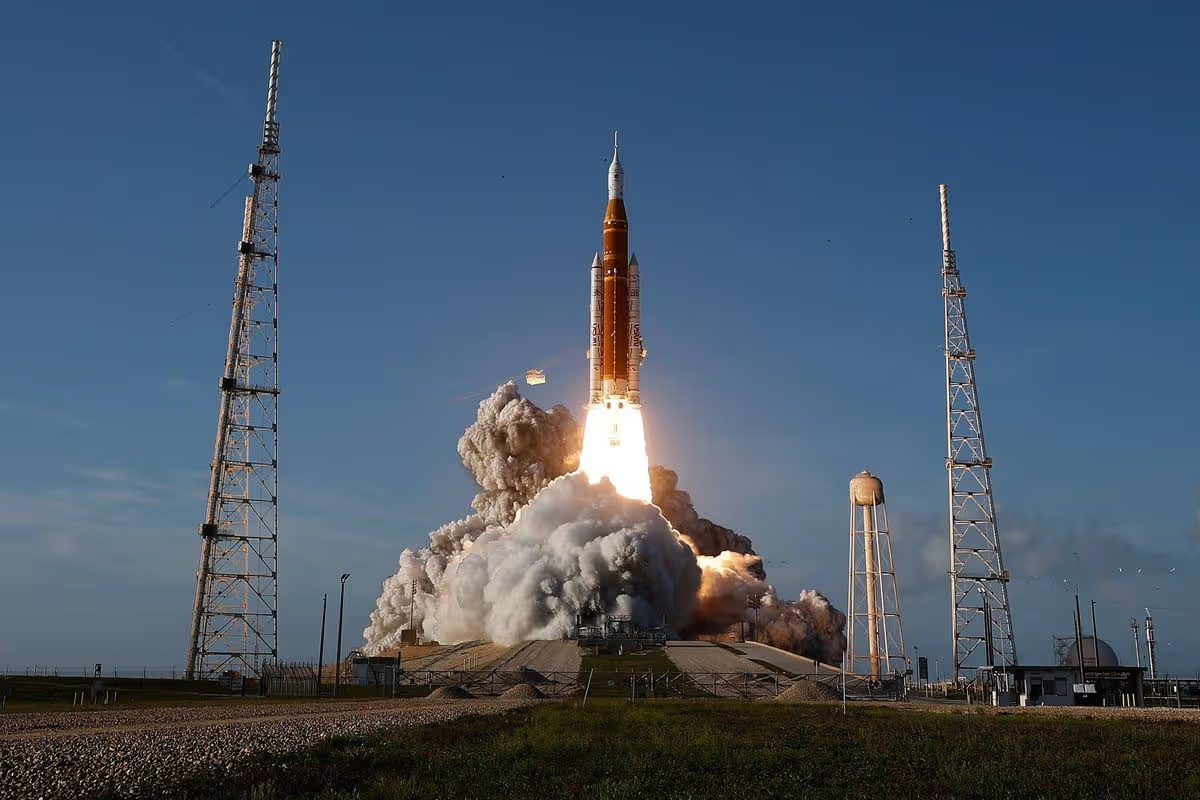
The Artemis II mission flew four U.S. astronauts around the Moon for the first time since 1972. Among them were the first black astronaut, first female, and first Canadian.
https://www.nasa.gov/centers-and-facilities/johnson/artemis-ii-mission-milestones-an-image-and-video-recap/

“I’m not really a religious person but there was no other avenue for me to explain anything or experience anything,” he said.

“So I asked for the chaplain on the Navy ship to just come visit us for a minute. When that man walked in – I’d never met him before in my life – but I saw the cross on his collar and I just broke down in tears.”
https://www.dailymail.com/sciencetech/article-15741363/NASA-astronaut-finds-GOD-returning-Earth.html

The “Black Irish” are erroneously claimed to be the descendants of shipwrecked sailors from the 1588 Spanish Armada who interbred with local people. In fact, the Black Irish are the island’s original inhabitants, and they can trace their lineages back in Ireland to prehistoric times.
https://youtu.be/Y5zUSkqMb7o?si=ir1ePIpx6P6bhsDT

A new study provides the strongest evidence ever of evolutionary pressure in the Near East and Europe as a result of the rise of agriculture starting around 10,000 years ago.
https://www.nature.com/articles/s41586-026-10358-1

A new study shows magic mushrooms are an effective treatment for depression.
https://www.economist.com/science-and-technology/2026/02/19/a-psychedelic-medicine-performs-well-against-depression

Donald Trump has fast-tracked research into hallucinogenic treatments for mental illness.
https://apnews.com/article/ibogaine-psychedelic-trump-fda-ptsd-veterans-kennedy-a9940fa57fa1457fc064eb5165003524

Trump as reclassified marijuana to a lower level of hazard.
https://apnews.com/article/medical-marijuana-rescheduling-justice-department-trump-cannabis-1d6722d3aae122b1a91f8e4b6c690268

The hallucinogen “DMT” is the most effective cure known for cluster headaches. ‘Because DMT is so fast-acting, patients can easily titrate it: take a puff from a vape pen, wait 30 seconds, take another puff — until the attack is gone completely, and before DMT’s psychedelic effects kick in. DMT has a very short half-life of 5–15 minutes, so even if you accidentally overdid it, you’d only need to wait a few minutes for the psychoactive effects to subside.’
https://psychotechnology.substack.com/p/near-instantly-aborting-the-worst

‘Gene therapy for a rare type of deafness shows lasting results’
https://www.npr.org/2026/04/22/nx-s1-5791478/gene-therapy-deafness-hearing

Titan of genetics, J. Craig Venter, is dead at 79.
https://www.jcvi.org/media-center/j-craig-venter-genomics-pioneer-and-founder-jcvi-and-diploid-genomics-inc-dies-79

‘Man Traveled 10,000 Miles and Spent Nearly $40,000 to Cryogenically Freeze His Sick Dog So They Can Reunite in the Future’
https://people.com/australian-man-spent-nearly-40000-dollars-to-cryogenically-freeze-his-sick-dog-11930160

There’s a new human cryopreservation company called “Nectome.”
https://www.lesswrong.com/posts/3i5GMhpGbDwef9Rns/nectome-all-that-i-know

Human lifespan is about 50% heritable, which is more than previously thought.
https://www.science.org/doi/10.1126/science.adz1187

Transgendered people have extremely high rates of mental illness and suicidality. Unfortunately, there’s no evidence that getting sex change operations during their teen years improves their mental health later on.
https://dailydeclaration.org.au/2026/04/07/after-gender-reassignment/

Review: “M3GAN 2.0”

[Written with the help of GPT-5]

Plot:

“She’s back!”

In M3GAN 2.0, the terrifying AI doll returns in a story that leans more into action, humor, and moral ambiguity than the original. The film follows Gemma (played by Allison Williams) as she grapples with the consequences of her earlier creation while navigating a rapidly escalating technological arms race. A new and more dangerous robot—AMELIA—emerges, with her own mysterious agenda, and forcing former enemies into uneasy alignment.

This movie is all about M3GAN’s redemption arc. Instead of being purely a villain, she becomes something closer to an antihero: still sharp-tongued and unsettling, but now positioned as a necessary ally against a greater threat. The dynamic between M3GAN and Gemma drives much of the story, blending tension, dark comedy, and reluctant trust.

The film expands its scope significantly, introducing corporate conspiracies, experimental technologies like brain implants, and high-stakes set pieces ranging from covert infiltrations to chaotic public confrontations. That broader ambition comes with a tradeoff—I didn’t like how this movie’s plot was more convoluted than the first movie’s. There are more moving parts, more characters, and more overlapping agendas, which can make the narrative feel cluttered at times.

Still, I thought the movie was fun and funny and Allison Williams was stunning. The humor lands more often than in the original, and M3GAN’s personality is given more room to shine, especially in her interactions with humans. The film balances its darker sci-fi elements with moments of levity and spectacle, making it an entertaining, if occasionally overcomplicated, continuation of the story.

Analysis:

Though no year is given for the movie’s events, it is clearly set either in the present day or at most five years from now.

Handcuffs won’t work on robots. At the start of the film, the evil gynoid AMELIA is captured by Iranian soldiers who mistakenly believe she is human. They restrain her with standard handcuffs. Once they lower their guard, she easily breaks free by pulling the cuffs apart with her bare hands. This depiction is largely realistic, with an important caveat.

AMELIA

AMELIA is clearly a specialized combat and infiltration machine, like the T-800 from the Terminator films. A robot designed for that role would likely possess strength far beyond human limits, allowing it to break restraints such as handcuffs, zip ties, or even more robust confinement systems intended for people. More broadly, many elements of the built environment that restrict human movement—locked doors, fences, barbed wire, or walls—would not reliably stop such a machine.

Fortunately, this kind of capability would not be typical. Most real-world robots will be task-specific or general-purpose assistants designed to operate safely around humans. That implies limits on strength, speed, weight, and durability, as well as the absence of combat-oriented programming. In other words, AMELIA represents an extreme edge case rather than a baseline for future robotics.

While I am not aware of any current humanoid robot capable of breaking handcuffs, there is no fundamental engineering barrier to building one. The film’s prediction is therefore plausible in principle, even if it reflects a niche category of machines.

Robots will use excessive force to kill humans. AMELIA surprises and attacks her captors, killing one by punching him so hard that his head is severed from his body. While a sufficiently strong machine might be capable of such force, the depiction is unrealistic in how that force is applied.

A system designed for lethal efficiency would not rely on extreme, energy-intensive blows. Instead, it would favor precise, minimal-force strikes to vulnerable areas such as the throat, neck, or head. A metal hand delivering a controlled but targeted impact would be more than sufficient to incapacitate or kill a human, and would do so with far less energy expenditure. As I wrote in my Terminator Salvation review, hand-to-hand combat with killer robots will be brutally skillful and done in seconds.

To the film’s credit, it later presents a more plausible approach. In a subsequent scene, AMELIA disables one FBI agent by striking his windpipe and knocks another unconscious with a controlled punch. This reflects a more realistic model of how an advanced machine might apply calibrated force.

A related scene involves M3GAN defending herself against armed attackers at a gala party event. She uses martial arts techniques to quickly and nonlethally subdue them. This raises an important point about how machines might handle violent encounters. Unlike humans, robots would not experience fear, panic, or hesitation, and they would not depend on imperfect training under stress. As a result, they could consistently apply the minimum force necessary to neutralize a threat.

Humans—especially police—often resort to lethal force in part because of fear, uncertainty, and limited confidence in close-quarters combat. Robots would not share these limitations. Their “lives” would not be at risk in the same way, either because their cognition is backed up remotely or because their bodies are more durable than human ones and immune to punches, knives and even bullets. Even in cases where they are vulnerable, they would not be driven by self-preservation in the same emotional sense. Some might not be programmed to value their own lives.

Because of this, many encounters that humans perceive as life-or-death would not be for machines. Robots could take actions that would be extremely risky for a person, enabling them to resolve dangerous situations with precision and restraint. With appropriate design, this could allow them to reduce the overall level of violence in such encounters.

Finally, since machines will lack emotions (or at least be able to turn their emotions off at will), they won’t be subject to fatigue, stress, anger, or other emotional states that undermine human judgement and training during crises. They will be completely cool and rational in even the most intense confrontations. Instead of robots mass murdering people, we could live in a future where they behave in ways that sharply decrease the number of violent human deaths, worldwide. And for the reasons I’ve mentioned in this section, robots will make better police officers than humans.

There will be brain implants that let people merge minds with other humans and machines. The film introduces a powerful but highly speculative technology in the form of advanced brain implants. Early in the film, an arrogant tech billionaire demonstrates one embedded in his own skull, and late in the film, Allison Williams’ character is forcibly given a similar device.

Allison Williams with a brain implant

These implants are depicted as deeply integrated into the brain, enabling telepathic communication, sensory sharing (e.g. – seeing what the other person’s eyes are seeing), and even remote control of another person’s body. Allison Williams allows this when she needs M3GAN’s fighting skills to beat up enemies. Users can “speak” to one another though internal dialogue, exchange visual perspectives, and override motor functions.

This portrayal is not consistent with the current state of technology or any credible near-term trajectory.

The core difficulty lies in the nature of the brain itself. The brain does not transmit simple, discrete commands that can be easily intercepted and replicated. Instead, it operates through complex, distributed patterns of neural activity that are still not fully understood. Accurately reading intent, translating it into motor output, and maintaining real-time sensory feedback would require breakthroughs across neuroscience, computation, and bioengineering.

There are also major engineering challenges. Current neural interfaces can only interact with a tiny fraction of neurons, signals degrade over time, and biological responses such as scar tissue can interfere with implants. Additionally, spinal and cortical systems are not passive conduits—they actively process and transform signals.

The film also depicts immediate recovery and full functionality after implantation, which is highly unrealistic. Even in a mature version of this technology, such a procedure would likely involve significant medical recovery time, extensive calibration, and a prolonged training period.

Finally, the visual design of the implant—a metallic device protruding from the skull—is implausible from a user-acceptance standpoint. Real-world designs would almost certainly prioritize minimal visibility for aesthetics.

Overall, this is not a near-future technology. It remains speculative and likely requires decades of advancement before anything approaching this functionality becomes possible. As I wrote in my big list of future predictions, I think we’ll have to wait until 2100 for this technology to exist. Furthermore, as I said in my review of “Physics of the Future”, brain implants will not be externally visible and won’t take the form of metallic protuberances coming out of people’s skulls since humans will find that ugly.

Cybernetics will have cured spinal cord damage. The film also presents a dramatic medical breakthrough: the arrogant billionaire stands up from his wheelchair, revealing that cybernetic implants in his spine have restored his mobility.

The arrogant, disabled billionaire

This technology doesn’t exist, nor will it in the near future, so this depiction is incorrect. Moreover, as I’ve said in my big list of future predictions, I don’t think the technology will exist until the 22nd century. ChatGPT explains the formidable hurdles:

The spinal cord is not simply a bundle of wires transmitting signals from the brain to the body. It is a complex processing system that integrates signals, coordinates movement, and manages reflexes. Bypassing a spinal injury would require recreating highly specific patterns of neural activity rather than simply rerouting a signal.

Another major challenge is decoding the brain’s “language” of movement. Motor commands are distributed across large populations of neurons and are continuously adjusted based on sensory feedback. A functional system would need to read these signals, translate them into precise stimulation patterns in the spinal cord, and maintain a real-time feedback loop.

There are also practical limitations. Current electrode technology cannot interface with enough neurons to replicate natural movement, and implants often degrade over time due to biological responses. Additionally, many spinal injuries involve complex damage rather than clean breaks, further complicating intervention.

That said, early experimental systems have shown promise. Some patients have regained limited ability to stand or take assisted steps using brain–spine interfaces. These results demonstrate that the concept is viable, but fully restoring natural, fluid movement remains a long-term challenge.

Terminators will exist. AMELIA is essentially the same thing as a T-800 from the Terminator films–a humanoid machine that looks externally the same as humans but is gifted with superior strength, speed, and fighting skills, and designed to infiltrate human spaces and to destroy targets. M3GAN’s upgraded body is about as capable. While impressive advances in robots have been recently made, we’re still far from being able to make machines that are this sophisticated, so this prediction the movie made will fail. As I’ve said in my reviews of Prometheus and The Terminator, I doubt androids with these constellations of traits will exist until near the end of this century.

AI will help you navigate the world in real time. One of the film’s more grounded ideas appears in a scene where Allison Williams’ character attends a gala while receiving real-time guidance from M3GAN through an earpiece. It presumably has a small microphone that transmits the sound of her own voice. M3GAN can see her surroundings and provide context-sensitive advice, such as warning her about suspicious individuals or suggesting specific actions (e.g. – “Search his pockets for an access card.”). It’s unclear how the visual data is being transmitted, but maybe she is wearing a tiny camera device on her clothing, or M3GAN has hacked into the building’s surveillance camera system.

This depiction is largely accurate as a near-term prediction.

Modern AI systems—particularly large language models—are already capable of providing useful guidance across a wide range of scenarios. The remaining challenge is integration: combining audio input, visual perception, and real-time processing into a seamless, wearable system.

A setup involving an earbud and a camera-equipped smartphone (or similar device) could plausibly achieve this (this was shown in the film Her, in which the main character also wore and earbud and kept a smartphone in his front breast pocket with the camera unobstructed and facing forward). With continued advances in multimodal AI and hardware miniaturization, such systems could become affordable and widely available within the five years.

Exoskeletons will be able to move around on their own. One piece of technology Allison Williams’ company has developed is a powered, full-body exoskeleton for disabled people. It has integral arms and legs connected to a flat torso, and each part tightly mirrors the wearer’s corresponding body part. Early in the film, her male employee puts it on a demonstrates how it works. Around the midpoint of the film, AMELIA seizes control of it remotely and uses it to chase down and attach the company’s female employee.

While there already are exoskeletons for disabled people, they are intended for people with weak or disabled legs and as such only have legs and lack arms. Full-body units meant for people with complete paralysis below the neck don’t exist and almost certainly won’t in the next five years, so this depiction of the present/near future is wrong. However, the film’s underlying logic contains an important insight.

An exoskeleton must be capable of maintaining balance, coordinating movement, and supporting both its own weight and that of its wearer. This implies that, in principle, it should also be capable of operating without a human inside it. In fact, removing the human simplifies the control problem by eliminating unpredictable movements and reducing load.

Additionally, a properly designed exoskeleton would route forces through its own structure rather than through the human body. If the machine lifts a heavy object, the load would be borne by the mechanical frame, not the wearer. (I touched on this in my review of Edge of Tomorrow.)

Given these considerations, it is reasonable to conclude that some future exoskeletons could move autonomously and even be remotely controlled. The film’s depiction is therefore conceptually sound, even if its timeline is optimistic. So, yes, in the future, some kinds of exoskeletons could, by themselves, chase people down and beat them up with their arms. And if they were connected to the Internet, other people or AIs might be able to hijack them and to remotely command them to do the same.

Exoskeletons won’t be waterproof. The characters defeat the hijacked exoskeleton by dumping a fish tank full of water on it, which short-circuits its electronics. This will prove inaccurate.

If exoskeletons are intended for real-world use, they would need to operate in a variety of environments, including exposure to water. Basic waterproofing and environmental sealing are standard engineering practices for modern electronics and machinery. A system as complex and expensive as a full-body exoskeleton would almost certainly be designed to withstand such conditions.

Robots will be able to detect your vital signs by touching you. At the gala party, M3GAN and AMELIA have their first real confrontation. AMELIA kicks Allison Williams hard enough to knock her unconscious and send her skidding across the floor. M3GAN runs to Allison to make sure she’s still alive, and uses her hand to open her eye and to visually scan it, revealing her heart rate, body temperature, and blood oxygen levels. This depiction is partially plausible but flawed in its details.

Allison Williams getting checked out

It is possible to tell heart rate from subtle visual cues, including changes in blood flow visible in the face or eyes, though this requires sensitive instrumentation. However, the eyes do not provide information about body temperature or blood oxygen levels.

A more plausible approach would involve sensors placed on the forehead, particularly over the temporal artery. Heart rate is of course measurable there, infrared thermometers can measure core body temperature from this location, and optical sensors can estimate blood oxygen levels by analyzing light reflected off the skull. These technologies could, in principle, be miniaturized and integrated into a robot’s fingertip, allowing it to gather multiple vital signs through touch.

Of course, no robots have this feature today, nor are they likely to within five years, so the movie’s depiction is wrong. Whatever the case, in the future, I’m sure domestic robots will have the ability to quickly and accurately take vital signs from humans, either thanks to inbuilt sensors or knowledge of how to use basic medical devices.

Robots will entertain you. At the emotional nadir of the film, when all seems lost, Allison Williams and M3GAN are back at their base, alone. As Allison nearly breaks down crying over their predicament, M3GAN first offers consoling words, and then suddenly breaks into a situationally appropriate song–“This Woman’s Work” by Kate Bush. I thought this was hilarious and recommend you watch it to raise your own spirits, and I also think it’s an accurate and surprisingly important depiction of how machines will soon interact with humans.

Anyone who has played around with LLMs knows they’re capable of producing good poetry, funny jokes, understanding countless nuances of the human experience, and rendering good advice on what to do or not to do in specific situations. With entirely reasonable advances in the technology and in the interfaces through which we interact with them (the earbud + forward-facing camera setup I mentioned earlier), it’s likely we’ll have disembodied AIs that can be invisibly present around us at all times and keep us entertained with jokes, songs, or interesting conversation. Five years is a reasonable timeline for such a thing. And there’s no reason to think the companion robots we’ll have in the farther future won’t be endowed with those same attributes.

The implications of this for quality of life for billions of people are profound. Imagine an easing of loneliness, and every day being simply funnier and more entertaining. We’ve been so fixated on the consequences of machines acquiring our job skills and intelligence that we’ve overlooked the upsides of what happens when they’re as funny and as fun as we are.